


Prefer the print book? Buy on Amazon
As an Amazon Associate, Sumizeit earns from qualifying purchases.
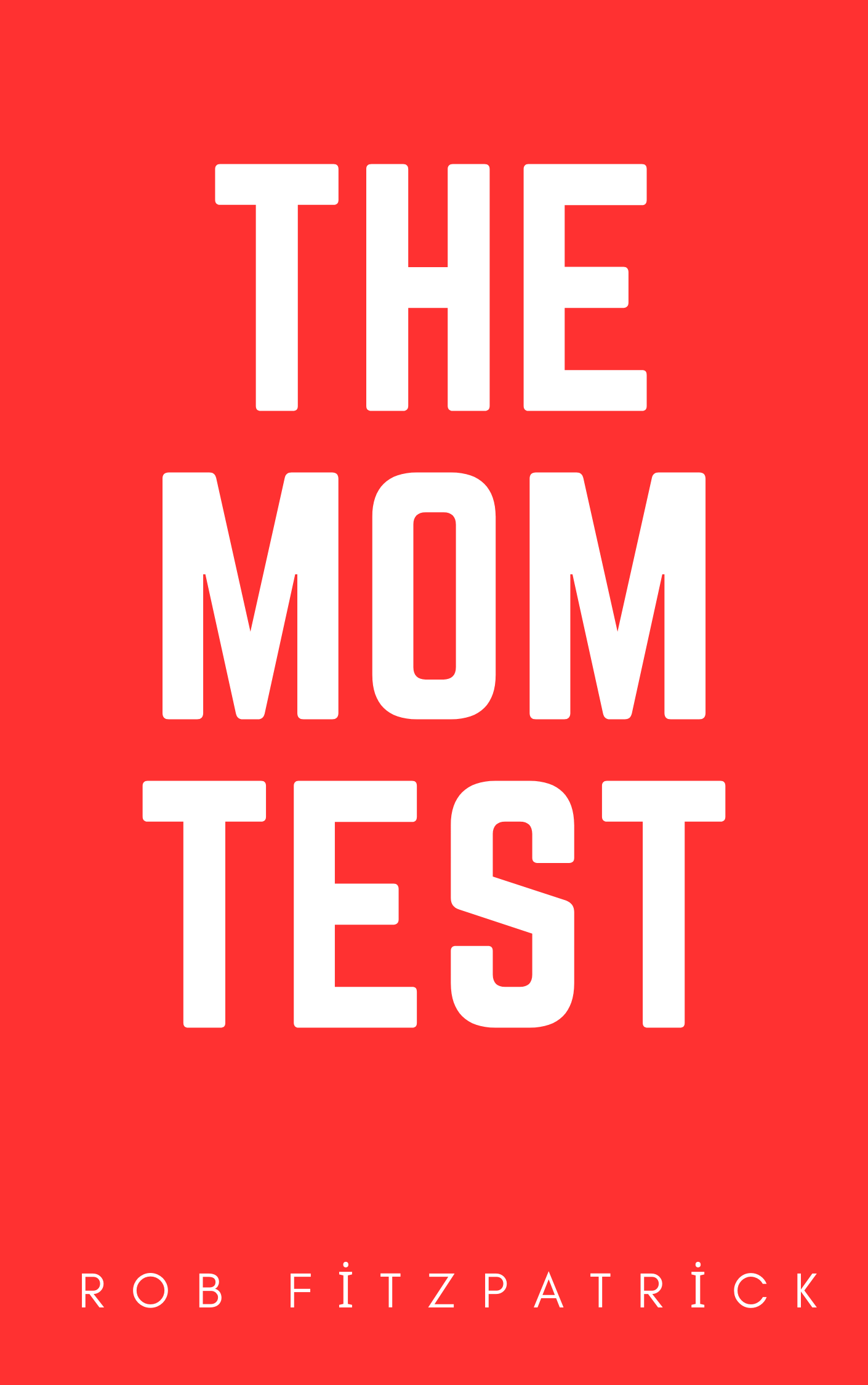
The Mom Test Book Summary
This The Mom Test Book Summary covers the key ideas, lessons, and takeaways in about 20 minutes.
Short Description:
Startups succeed by validating ideas with honest customer feedback.
Helps with these goals
Preview the The Mom Test book summary
Below is a preview of Sumizeit’s comprehensive human-written summary of The Mom Test by Rob Fitzpatrick. The full summary is 15-20 minutes long and covers the book’s key ideas in text, audio, visual, and video formats. Unlock the full 20 Minute Summary
Everyone wants to have a successful business but only some make it through. If you’re starting out, you need to know whether your business idea is really worth pursuing. How do you find that out? It turns out that asking your friends, family, and the people close to you is the most futile thing you can do.
The Mom Test by Rob Fitzpatrick provides the tools with which you can decide whether your idea is actually good or do people just tell you it’s good because they don’t want to hurt your feelings.
Rob talks about how to strike the right conversations, how to find the right people to talk to, how to filter out fluff, making your business customer-focused, and embracing bad news with open arms. This book will help you get in the right mindset of doing business and equipping you with the tools to become a star entrepreneur.
Don’t ask anyone whether your business idea is clever
You’ve come up with a brilliant business idea and want to share it with someone, who do you share it with first? It’s almost instinctive that you’ll share it with your friends and family because they’re the people closest to you. But that’s actually a bad idea. Why? Here comes the mom test.
The mom test is simple. If you ask your mom, or someone you’re close to, “what do you think about my business idea?,” they’ll probably tell you, “it’s great. Go for it!” But is it really that great? People close to you don’t want to hurt your feelings or discourage you, so they’ll lie to you. That’s why they say, never look for the truth in your mother’s eyes.
Collecting false positives is a no-go if you’re an entrepreneur. After all, you’re serious about your business and you want to keep yourself grounded instead of immersing yourself in praise. The best way to get that reality check is to understand the real problems of your prospective customers. The question is, how?
The answer is pretty simple — be honest in your conversations. Don’t mistake that for generic advice because it’s not. Think about it. Will you ever be completely honest with someone knowing that your honesty will hurt them? The answer is no. So, why would others be honest if they’re uncomfortable?
Genuine conversations are honest, and honesty comes from being comfortable. People can only open up to you and be honest about something if they feel comfortable. What’s the key to holding genuine conversations, then?
Instead of talking to people about your idea, ask them about their life, the problems they face every day. Remember to make your conversations about them and listen more than you talk. When they’ll see how much you are invested in them, they will open up and give you their honest opinions. That’s the data you’re looking for.
The goal is to recognize peoples’ pain points — what bothers them and what kind of solutions they want.
Want the complete 20-minute summary?
- Full structured summary
- Video Summary
- Podcast Summary
- Audio summary
- Key takeaways
- Exercises
- Quiz
- Highlights and notes
- Ask the book with AI
Who should read The Mom Test?
The Mom Test is essential for entrepreneurs, startup founders, and business innovators who want to validate their ideas before investing time and money. If you're launching a new product or service and need honest feedback rather than polite encouragement, this book provides the framework you need. Anyone struggling to distinguish genuine customer interest from supportive lip service will find practical, actionable guidance here.
Why does The Mom Test matter?
Most startup failures stem from building products nobody actually wants—often because founders relied on feedback from people too polite to be honest. The Mom Test cuts through this problem by teaching you how to have conversations that uncover real customer pain points instead of collecting false validation. In today's fast-paced startup ecosystem, learning to validate ideas quickly and ruthlessly separates successful founders from those who waste resources on doomed ventures.
What are the key themes in The Mom Test?
- Distinguishing genuine customer insight from polite feedback
- The danger of seeking approval instead of understanding customer needs
- Customer-centric business thinking over ego-driven entrepreneurship
- Learning to embrace rejection as a path to success
- Targeting specific customer segments rather than broad audiences
- Taking action and data over words and promises
How can you apply ideas from The Mom Test?
- Before launching any new product, conduct 10-20 customer conversations focused on their problems rather than your solution
- Create a list of diagnostic questions to ask customers about frequency, severity, and previous solution attempts for their stated problems
- Identify and define your most specific target customer segment using demographic, behavioral, and motivational criteria
- Track customer responses across conversations to identify patterns in what problems recur and which customer segments are most engaged
- Set up a metrics system to measure whether people take action (paying, signing up, or using your product) rather than relying on verbal commitments
- Schedule regular customer learning sessions as a non-negotiable part of your business calendar, not just a startup activity
- Document bad news and rejections explicitly, then analyze what they tell you about your idea, positioning, or target market
What common mistakes do readers make with The Mom Test?
- Asking friends and family for feedback on your business idea, then believing their positive responses constitute validation
- Pitching your solution before understanding whether the customer actually has the problem you're trying to solve
- Targeting too broad an audience and trying to appeal to everyone rather than narrowing your focus to a specific segment
- Accepting verbal commitments like 'I'd definitely buy that' as proof of market demand without requiring actual payment or concrete action
Sumizeit Exercises Apply what you've learned
Turn ideas from The Mom Test into action with a short guided reflection: identify the biggest takeaway, connect it to your life, and commit to one step you can take in the next 24 hours.
What is the expert analysis of The Mom Test?
Overview
The Mom Test is a pragmatic guide authored by Rob Fitzpatrick, an entrepreneur with over a decade of hands-on experience in launching and scaling businesses. The book addresses a fundamental challenge faced by startups and innovators: how to obtain honest, actionable customer feedback without falling prey to the comforting but misleading affirmations of friends, family, or casual acquaintances. Fitzpatrick’s work stands out in the crowded field of entrepreneurial literature by focusing on the subtle art of asking the right questions, fostering genuine conversations, and interpreting customer insights with a critical lens. Its significance lies in its practical methodology that helps entrepreneurs avoid common pitfalls early in the product validation process, thereby increasing the likelihood of building ventures grounded in real market needs.
Core Thesis
The central argument of The Mom Test is that traditional methods of soliciting feedback on business ideas are fundamentally flawed because people tend to provide polite, encouraging responses rather than truthful critiques. Fitzpatrick posits that entrepreneurs must reframe their approach to customer conversations by avoiding direct questions about their ideas and instead focusing on understanding customers’ actual problems and behaviors. The book advocates for a disciplined, customer-centric mindset where the goal is not to seek approval but to uncover honest insights, even if they are negative. This process, according to Fitzpatrick, is essential to avoid the costly mistake of building products based on false positives and to ultimately create solutions that address genuine customer pain points.
Strengths
- Practical Framework: Fitzpatrick provides clear, actionable advice on how to conduct customer interviews, including specific questions to ask and pitfalls to avoid, making the book immediately useful for entrepreneurs at any stage.
- Focus on Honesty and Comfort: The emphasis on creating a comfortable environment for honest dialogue is psychologically astute, recognizing the social dynamics that often distort feedback.
- Customer-Centric Mindset: By shifting the focus from selling an idea to understanding customer problems, the book aligns with best practices in design thinking and lean startup methodologies.
- Embracing Negative Feedback: Fitzpatrick’s encouragement to seek out and learn from bad news reframes failure as a critical step toward success, which is a valuable mindset for resilience in entrepreneurship.
- Conciseness and Accessibility: The book is concise and written in an accessible style, making complex concepts digestible without sacrificing depth.
Critiques & Counterarguments
- Potential Oversimplification: While the book’s advice is clear, it may understate the complexity of human communication and the nuances involved in interpreting customer feedback, especially in diverse cultural contexts where directness varies.
- Limited Scope on Market Dynamics: Fitzpatrick’s focus is heavily weighted toward early-stage customer conversations and may not fully address how to integrate these insights with broader market analysis, competitive dynamics, or long-term strategic planning.
- Competing Research on Customer Feedback: Some research in behavioral economics and psychology suggests that customers often lack full self-awareness of their needs or future behaviors, which can limit the reliability of any interview-based feedback, no matter how well conducted.
- Risk of Confirmation Bias: Entrepreneurs trained by the book might still fall into selectively hearing what confirms their hypotheses, especially if they are emotionally invested, which means the book’s method requires disciplined self-awareness beyond what is explicitly discussed.
- Real-World Evidence of Market Failure: Numerous startups have followed similar customer discovery processes yet failed due to factors beyond customer feedback, such as execution challenges, timing, or macroeconomic shifts, indicating that honest customer conversations are necessary but not sufficient for success.
Who Should Read This
The Mom Test is essential reading for early-stage entrepreneurs, product managers, and innovators who seek to validate their ideas through customer insights before significant investment. It is particularly valuable for those who are new to customer discovery or who have struggled with biased or unhelpful feedback. Additionally, business educators and startup mentors can benefit from its straightforward framework to teach effective communication strategies. However, seasoned entrepreneurs and executives may find it a useful refresher on the fundamentals of customer engagement, even if they require complementary resources for scaling and strategic growth.
Frequently asked questions about the The Mom Test book summary
What is The Mom Test about?
The Mom Test by Rob Fitzpatrick is a guide for entrepreneurs on how to validate business ideas through customer conversations that reveal honest feedback rather than polite approval. The core premise is that asking your mom (or anyone close to you) directly whether your idea is good will get you false positives because people don't want to hurt your feelings. Instead, Fitzpatrick teaches you how to have genuine conversations focused on customers' problems and pain points, which provides the real data you need to decide whether your idea is worth pursuing.
Who should read The Mom Test?
The Mom Test is essential for startup founders, entrepreneurs, product managers, and business innovators who are launching new ideas or products. Anyone who has struggled to get honest feedback from customers, or who suspects that praise they've received might be hollow encouragement rather than genuine validation, will benefit from this book. It's particularly valuable for first-time entrepreneurs who tend to seek approval rather than truth.
What are the main takeaways from The Mom Test?
The main takeaways are: stop asking people directly whether your business idea is good, start having conversations about their problems and pain points instead, learn to filter out fluff and identify genuinely motivated customers, embrace bad news as valuable learning rather than rejection, narrow your target audience to a specific segment, and make your business customer-focused rather than ego-driven. Most importantly, seek truth through action and data rather than verbal commitments.
How do you distinguish real customer interest from politeness?
Real customer interest emerges when people actually take action—paying money, signing up, or using your product—rather than just saying they will. Additionally, genuinely interested customers can answer detailed diagnostic questions about how often they face the problem, what they've tried to solve it, and what the ideal solution would look like. People who are just being polite tend to give vague answers and won't follow through with concrete steps.
Why is narrowing your target audience important?
A narrow, specific target audience allows you to deeply understand exactly what one group of customers needs and why, rather than spreading your efforts across too many segments. This focus ensures your product solves a specific pain point for a defined group rather than being a generic solution that appeals to nobody. Entrepreneurs who try to serve everyone end up with scattered resources and products that don't truly satisfy any segment.
What questions should you ask during customer conversations?
Effective customer conversation questions focus on their daily problems and experiences rather than your idea. Ask about when they last faced the problem, how often it occurs, what solutions they've already tried, what they're currently doing to cope, and what they think the ideal solution would be. These questions reveal the genuine severity and frequency of their pain while demonstrating your authentic interest in their world rather than your solution.
How do you know if you should abandon your business idea?
You should seriously reconsider your idea if customers consistently struggle to answer questions about their problem's frequency and severity, if no one is willing to take action despite claiming interest, or if you discover existing solutions already adequately address the problem. The key is that bad news and rejection aren't personal failures—they're data points that save you from pursuing a doomed venture and redirect your energy toward a better opportunity.
About Sumizeit
Sumizeit is a profitable Scomy LLC company based in Miami, Florida. Our founders, Clemens Raemy and Weina Scott, are successful entrepreneurs with several exits. Sumizeit is a popular book summary app / micro learning app used by busy professionals and entrepreneurs with over 2,500 non-fiction book summaries and 10,000 podcast summaries in text, audio, visual, podcast, and video format. We also have stellar retention tools to make ideas stick - such as flashcards with spaced repetition, quizzes, streaks, highlighting and notes, daily challenges, riddles, mini-courses, meditation, and more. You won't only learn the idea, but also remember it. Over 90% of our users change their habits with Sumizeit.
Upgrade Now
Here's why readers love Sumizeit
Join thousands of learners getting smarter every day
"Great experience. Detailed summaries. Loved the gamification feature. Makes learning fun. Good customer service. I recommend Sumizeit to anyone. You'll learn a lot."
"I always felt busy but still wanting to keep up with the book discussion in my friend group. This was a great supplement to help me keep reading the books I find fun while keeping up with important books."
"I love this website. Instead of scrolling social media, I find myself learning a lot. I use it everyday. I recommend this app for anyone who is too busy and wants to get up to speed with their favorite books."
The Mom Test Book Summary PDF
Looking for a The Mom Test Book Summary PDF you can save and revisit offline? Our The Mom Test Book Summary PDF captures the book’s core ideas in a clean, printable format — the key frameworks, takeaways, and structure without the fluff. Download the The Mom Test Book Summary PDF when you want a reference you can annotate, share with your team, or review on the go. Get your The Mom Test Book Summary PDF from the download page below.
Download The Mom Test Book Summary PDFPeople also liked these summaries
Readers who explored The Mom Test often enjoyed these titles next.


Ready to read the whole thing?
- Full structured summary
- Video Summary
- Podcast Summary
- Audio summary
- Key takeaways
- Exercises
- Quiz
- Highlights and notes
- Ask the book with AI
Featured Book Titles
Popular Book Summaries at sumizeit, leading book summary app