


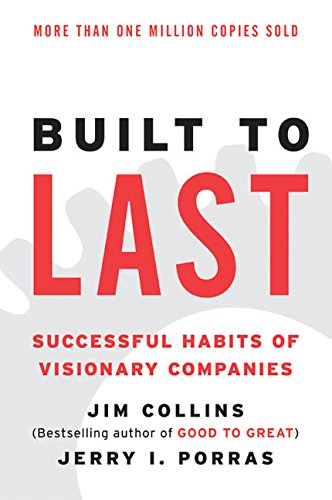
Prefer the print book? Buy on Amazon
As an Amazon Associate, Sumizeit earns from qualifying purchases.
Built to Last Book Summary
This Built to Last Book Summary covers the key ideas, lessons, and takeaways in about 20 minutes.
Short Description:
Visionary companies succeed by staying true to core values and fostering growth.
In order to achieve success, visionary companies create core values for themselves that they stay true to, even as they pursue new goals. However, it is not just about values, it is also an ideology that includes its purpose as a company, which is simply the reason the business exists.
Visionary companies do not just exist for profit, but by continuing to grow while staying true to their ideologies, they will ultimately find a way to make money.
These companies are all about creating big goals, stimulating growth, and developing strong leaders who are able to take on leadership roles as needed.
Helps with these goals
Want a Free Weekly Read?
Get a free summary every week straight to your mailbox.
Preview the Built to Last book summary
Below is a preview of Sumizeit’s comprehensive human-written summary of Built to Last by Jim Collins. The full summary is 15-20 minutes long and covers the book’s key ideas in text, audio, visual, and video formats. Unlock the full 20 Minute Summary
While we might believe that the success of a company is dependent on them having great ideas, this is not always the case, at least not at the start. In many cases, the most successful businesses chose to brainstorm after they had already formed their company.
In Built to Last: Successful Habits of Visionary Companies, Jim Collins and Jerry I. Porras discuss the ways different companies and leaders have been able to not only achieve success but also continue being successful. And while you may think you do know what makes a company or a leader successful, you may be surprised by the reality of what it takes to last in business.
From Hewlett Packard to Sony, some of the most successful companies did not start with a great idea but rather tried different ideas until coming up with something innovative and different.
And while you may think that the company leader needs to be a visionary with a high-profile, this is not necessary either. In many cases, these leaders were more down-to-Earth and modest.
So the question becomes, how did these companies continue to succeed and grow when other companies did not?
How companies are built to last
In order to be a successful company that lasts, it is important not to focus on a single person, idea, or product. To become an “outstanding organization,” it is all about building yourself up and constantly producing new ideas that are great, and new leaders.
The founders of some of the greatest companies did not build their organization off of a great idea, but rather they created a company that was able to achieve greatness. By continuing to move forward without focusing on any one product or person, the great companies were able to remain successful.
Rather than just producing a great idea/product or leader, successful companies are able to do both. This allows them to work like a well-oiled machine.
Successful companies with a vision are driven by a core ideology that allows them to prosper without a focus on profits
For a company to truly be successful, it must have a higher purpose than just looking for profit. By having a core set of values that guide their decisions, these companies are able to endure difficulties that might crumble another business.
However, just because a company is principled, that does not mean that they are unable to profit. In many cases, even though profit was not the primary goal for a company, they were able to make pragmatic decisions about the business that still allowed them to make money without wavering from their core values.
By having a core ideology, when a business faces difficulties, it allows them to stop and clarify what they need to do in order to stand by their convictions.
An example used in the book comes from Ford and the issues they faced in the 1980s. As the authors pointed out, rather than just fighting fires, the company’s leaders took the time to…
Want the complete 20-minute summary?
- Full structured summary
- Video Summary
- Podcast Summary
- Audio summary
- Key takeaways
- Exercises
- Quiz
- Highlights and notes
- Ask the book with AI
Who should read Built to Last?
Built to Last is essential reading for entrepreneurs, business leaders, and managers who want to build organizations that endure beyond their own tenure. It's also valuable for anyone interested in understanding what separates legendary companies like Apple, Disney, and Hewlett-Packard from those that fade away. Whether you're starting a business or trying to revitalize an existing one, this book provides the blueprint for sustainable success.
Why does Built to Last matter?
In today's fast-paced business environment, many companies chase short-term profits and fail to establish lasting foundations. Built to Last challenges the myth that great companies are built on visionary leaders or single breakthrough ideas, instead revealing that longevity comes from core ideology, continuous improvement, and strong organizational culture. Understanding these principles helps leaders create businesses that survive market changes, leadership transitions, and competitive pressures while maintaining their fundamental values.
What are the key themes in Built to Last?
- Core ideology as the foundation for lasting success
- The power of bold, audacious goals to drive progress
- Balancing core values with flexibility and innovation
- Building strong organizational culture and leadership pipelines
- Experimentation and calculated risk-taking as drivers of evolution
- Profit as a consequence, not the primary purpose
- Long-term thinking over short-term gains
How can you apply ideas from Built to Last?
- Define your organization's core ideology and communicate it consistently across all hiring, training, and decision-making processes
- Set a bold 10+ year goal that seems nearly impossible but provides clear direction for strategy and resource allocation
- Establish clear mechanisms such as training programs, performance metrics, and promotion criteria that reinforce core values daily
- Create an experimentation budget and explicitly permission teams to test new ideas, with failure viewed as learning rather than punishment
- Build a succession plan by identifying and developing high-potential employees for future leadership roles within your organization
- Conduct regular strategic pauses to evaluate whether decisions and operations remain aligned with core values, adjusting practices as needed
- Design hiring processes that assess cultural fit and value alignment alongside technical skills and experience
What common mistakes do readers make with Built to Last?
- Assuming a visionary founder is necessary for success and failing to build systems and culture that outlive key individuals
- Setting modest goals that don't inspire or stretch the organization, leading to incremental growth rather than breakthrough progress
- Treating core values as marketing slogans rather than operational realities that guide everyday decisions and tradeoffs
- Pursuing short-term profits at the expense of long-term organizational health, culture, and strategic investments in future capability
Sumizeit Exercises Apply what you've learned
Turn ideas from Built to Last into action with a short guided reflection: identify the biggest takeaway, connect it to your life, and commit to one step you can take in the next 24 hours.
What is the expert analysis of Built to Last?
Overview
Built to Last: Successful Habits of Visionary Companies is a seminal work co-authored by Jim Collins and Jerry I. Porras, both respected figures in the field of business management and organizational studies. Published in the 1990s, this book stands as a cornerstone in understanding what differentiates enduringly successful companies from those that falter. Collins, with a background that spans consulting at McKinsey & Company and executive roles at Hewlett-Packard, brings rigorous research methods and practical insight to the study of corporate longevity. Together with Porras, the authors dissect the DNA of visionary companies, offering a blueprint that transcends mere profitability to encompass ideology, culture, leadership, and innovation.
Core Thesis
The central argument of Built to Last is that truly visionary companies are not built on a singular great idea or charismatic leader but rather on a robust core ideology that guides their purpose and values over time. These companies achieve lasting success by continuously evolving—experimenting boldly, cultivating successive generations of leaders, and setting audacious goals—while steadfastly preserving their foundational principles. Profit, while necessary, is not the primary driver; instead, a higher purpose and a commitment to core values enable these organizations to endure market fluctuations and leadership changes. The book posits that this balance between ideological constancy and adaptive progress is the hallmark of companies built to last.
Strengths
- Empirical Rigor: Collins and Porras base their conclusions on extensive longitudinal research, comparing visionary companies with less successful counterparts, which lends credibility and depth to their insights.
- Holistic Framework: The book transcends simplistic success formulas by integrating culture, leadership development, innovation, and ideology into a cohesive model.
- Practical Applicability: The concepts of core ideology, BHAGs (Big Hairy Audacious Goals), and the cult-like corporate culture provide tangible tools for leaders aiming to build enduring organizations.
- Timeless Principles: Despite being published decades ago, many of the principles remain relevant, emphasizing values and adaptability over transient trends.
- Balanced View on Profit: The nuanced discussion that profit is a byproduct rather than the sole objective challenges conventional business wisdom and encourages a more sustainable approach.
Critiques & Counterarguments
- Selection Bias and Survivorship: The study focuses on companies that have already succeeded, potentially overlooking firms with similar traits that failed, thus limiting the universality of its conclusions.
- Overemphasis on Ideology: Critics argue that the centrality of core ideology may oversimplify complex market dynamics and external factors such as technological disruption, regulatory changes, and economic cycles that also critically shape corporate fate.
- Cult-Like Culture Risks: While the book praises the intense cultural cohesion of visionary companies, this can border on insularity, potentially stifling dissent and innovation—a concern echoed by organizational psychologists who warn against groupthink and conformity pressures.
- Contrasting Research on Leadership: Some leadership theories emphasize transformational or charismatic leaders as pivotal, which contrasts with Collins’s assertion that visionary companies succeed despite modest, down-to-earth leadership, suggesting a more nuanced leadership impact.
- Changing Business Environment: The examples and case studies, many from the late 20th century, may not fully account for the rapid pace of change in the digital era, where agility and disruption sometimes trump long-term ideological consistency.
Who Should Read This
Built to Last is essential reading for business leaders, entrepreneurs, and organizational scholars who seek a profound understanding of what underpins enduring corporate success beyond short-term gains. It appeals to those interested in the intersection of business strategy, organizational culture, and leadership development. Additionally, readers with a philosophical bent on purpose-driven work and sustainable growth will find its insights compelling. However, those looking for quick-fix strategies or narrowly focused operational advice may find the book’s broad, principle-driven approach less immediately actionable.
Frequently asked questions about the Built to Last book summary
What is Built to Last about?
Built to Last: Successful Habits of Visionary Companies, by Jim Collins and Jerry Porras, examines what separates companies that endure and thrive for decades from those that fade away. The book reveals that lasting success isn't built on charismatic leaders or breakthrough ideas alone, but rather on core ideology, bold goals, strong culture, continuous innovation, and systematic leadership development that transcend any individual founder.
Who should read Built to Last?
This book is essential for entrepreneurs, CEOs, business leaders, and managers at any level who want to build organizations with lasting impact and longevity. It's also valuable for anyone studying business sustainability, organizational development, or leadership succession. Whether you're building a startup or revitalizing an established company, Built to Last provides a roadmap for creating enduring success.
What are the main takeaways from Built to Last?
The core takeaways are: establish a clear core ideology and values that guide all decisions; set audacious, seemingly impossible goals to inspire progress; maintain those core values while remaining flexible in how you execute and adapt; build a distinctive, high-performing culture where people are deeply aligned with the company's purpose; and develop internal leaders to ensure continuity and sustained success beyond any single individual. Built to Last demonstrates that companies driven by purpose, not just profit, ultimately achieve greater long-term financial success.
Do you need a visionary founder for a company to be successful?
No, according to Built to Last, visionary founders aren't necessary for company success. Many legendary companies like Hewlett-Packard and Sony had humble, down-to-earth founders rather than high-profile visionaries. What matters most is building an organization with strong core values, systems, and culture that transcend any individual and allow the company to succeed across leadership transitions.
How can I apply Built to Last principles to my organization?
Start by clarifying your core ideology and purpose beyond profit, then embed these values into hiring, training, and decision-making processes. Set bold long-term goals, create mechanisms that reinforce your values daily, encourage experimentation and learning from failure, and develop internal talent into future leaders. Most importantly, ensure these practices become organizational systems rather than depending on individual leaders to maintain them.
What's the relationship between core values and profitability in Built to Last?
Built to Last argues that profitability is a natural consequence of strong core values and purpose, not the primary goal. Companies that obsess over short-term profits often underperform, while visionary companies that prioritize their core ideology and long-term vision ultimately become more profitable. This counterintuitive finding shows that purpose-driven organizations make better strategic decisions and inspire greater commitment from employees and customers.
How does experimentation contribute to long-term success?
Built to Last shows that visionary companies treat business evolution like natural selection—through continuous experimentation, learning from failures, and adapting practices. Companies that encourage calculated risk-taking and don't punish failure evolve faster and innovate more effectively. Most experiments fail, but the cumulative learning from many small experiments drives significant competitive advantages and adaptation over time.
About Sumizeit
Sumizeit is a profitable Scomy LLC company based in Miami, Florida. Our founders, Clemens Raemy and Weina Scott, are successful entrepreneurs with several exits. Sumizeit is a popular book summary app / micro learning app used by busy professionals and entrepreneurs with over 2,500 non-fiction book summaries and 10,000 podcast summaries in text, audio, visual, podcast, and video format. We also have stellar retention tools to make ideas stick - such as flashcards with spaced repetition, quizzes, streaks, highlighting and notes, daily challenges, riddles, mini-courses, meditation, and more. You won't only learn the idea, but also remember it. Over 90% of our users change their habits with Sumizeit.
Upgrade Now
Here's why readers love Sumizeit
Join thousands of learners getting smarter every day
"Great experience. Detailed summaries. Loved the gamification feature. Makes learning fun. Good customer service. I recommend Sumizeit to anyone. You'll learn a lot."
"I always felt busy but still wanting to keep up with the book discussion in my friend group. This was a great supplement to help me keep reading the books I find fun while keeping up with important books."
"I love this website. Instead of scrolling social media, I find myself learning a lot. I use it everyday. I recommend this app for anyone who is too busy and wants to get up to speed with their favorite books."
Built to Last Book Summary PDF
Looking for a Built to Last Book Summary PDF you can save and revisit offline? Our Built to Last Book Summary PDF captures the book’s core ideas in a clean, printable format — the key frameworks, takeaways, and structure without the fluff. Download the Built to Last Book Summary PDF when you want a reference you can annotate, share with your team, or review on the go. Get your Built to Last Book Summary PDF from the download page below.
Download Built to Last Book Summary PDFPeople also liked these summaries
Readers who explored Built to Last often enjoyed these titles next.

Ready to read the whole thing?
- Full structured summary
- Video Summary
- Podcast Summary
- Audio summary
- Key takeaways
- Exercises
- Quiz
- Highlights and notes
- Ask the book with AI
Featured Book Titles
Popular Book Summaries at sumizeit, leading book summary app