Question 1 of 5
What main conclusion does the summary present about humans' ability to read strangers?
The summary's main take-away is that humans cannot understand strangers as well as they think and should be cautious before judging.


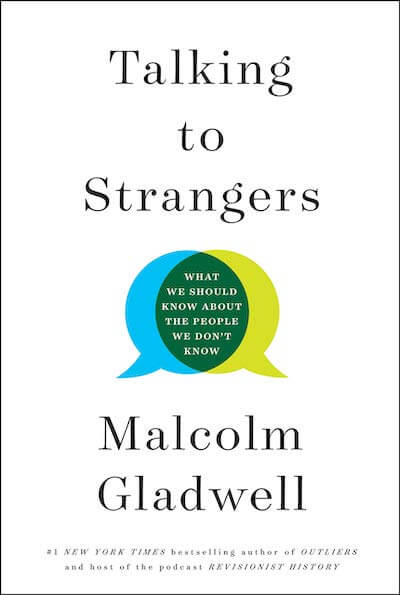
Prefer the print book? Buy on Amazon
As an Amazon Associate, Sumizeit earns from qualifying purchases.
This Talking to Strangers Book Summary covers the key ideas, lessons, and takeaways in about 20 minutes.
Helps with these goals
Want a Free Weekly Read?
Get a free summary every week straight to your mailbox.
Below is a preview of Sumizeit’s comprehensive human-written summary of Talking to Strangers by Malcolm Gladwell. The full summary is 15-20 minutes long and covers the book’s key ideas in text, audio, visual, and video formats. Unlock the full 20 Minute Summary
In life, we make assumptions and judgments on a regular basis.
Every time we see a person we don’t know, we immediately pass judgment on them, either consciously or subconsciously.
But, as humans, are we really that good at understanding strangers?
In “Talking Strangers”, Malcolm Gladwell gives us some key insights into why humans have such a hard time deciphering another person’s character. And, why we are often tricked by charming lies because of our trusting nature.
“The right way to talk to strangers is with caution and humility.”- Malcolm Gladwell
With Gladwell’s deep dig into human behavior, you will begin to understand why you should never ever judge a stranger.
Unfortunately, we are not as good at reading strangers as we think we are. And, this is true for people who work in a career where that is their main job.
In his book, Gladwell shares an example of Solomon, a bail judge in New York. Solomon’s job is to read the files of the inmates and also examine them face-to-face.
In 2017, Solomon and his team were put to a test. They were put up against artificial intelligence software to determine just how good they were at reading the inmates.
The results showed that the inmates released by Solomon and his team were 25% more likely to commit a crime than those that the technology chose to release.
“The conviction that we know others better than they know us—and that we may have insights about them they lack (but not vice versa)—leads us to talk when we would do well to listen and to be less patient than we ought to be when others express the conviction that they are the ones who are being misunderstood or judged unfairly.” -Malcolm Gladwell
Humans think they can read people using visual cues and body language. But, this is rather weak evidence of a person. We believe that strangers are easy-to-read, which contradicts our ideas about the complexity of the human race.
As humans, we assume people are telling the truth until deception becomes incredibly obvious.
Gladwell shares an example of Tim Levine, a scientist, who conducted an experiment in which the test subjects watched tapes of students who had just participated in a trivia test.
In the videos, Levine is seen asking the students questions about the trivia test, such as “did you cheat?” and “If I ask your partner, will she tell me the same?”
The results were that some of the cheating students lied through their teeth, while others confessed to their cheating ways immediately.
As the test subjects watch the video, Levine asks them to decide which students are lying and which are not. The results were about 50/50 with the test subjects correctly identifying the lying students.
Without a clear trigger to think the person is lying such as defensiveness or avoiding eye contact, the test subjects and humans, in general, are more likely to…
Talking to Strangers is ideal for anyone who makes judgments about people in their professional or personal life—including hiring managers, law enforcement, therapists, and everyday people navigating an increasingly diverse society. If you've ever felt misunderstood or struggled to accurately read someone's intentions, this book offers eye-opening perspective on why our intuitions often fail us.
In an era of polarization and cross-cultural encounters, understanding why we misjudge strangers has never been more important. Malcolm Gladwell reveals that our confidence in reading others far exceeds our actual ability, leading to costly mistakes in criminal justice, relationships, and business. This book challenges the dangerous myth that body language and facial expressions reliably reveal truth, offering a more humble and evidence-based approach to human interaction.
Turn ideas from Talking to Strangers into action with a short guided reflection: identify the biggest takeaway, connect it to your life, and commit to one step you can take in the next 24 hours.
"Talking to Strangers" is a compelling work by Malcolm Gladwell, a renowned Canadian journalist and author celebrated for his ability to distill complex social science research into accessible narratives. Gladwell’s reputation, established through bestsellers like "The Outliers," positions this book within a tradition of exploring human behavior through a psychological and sociological lens. The book’s significance lies in its challenge to the common assumption that humans are adept at reading and understanding strangers, a notion with profound implications for interpersonal trust, justice, and social cohesion.
Gladwell’s central argument is that humans are fundamentally poor at interpreting the intentions, emotions, and honesty of strangers. He posits that our default mode of interaction—assuming truthfulness and transparency—is both a social necessity and a source of vulnerability. Through a series of case studies and psychological experiments, Gladwell illustrates how this trust often leads to misjudgments, mistaken assumptions, and sometimes grave consequences. The book advocates for approaching strangers with caution and humility, emphasizing the complexity and opacity of human behavior beyond superficial cues.
This book is ideal for readers interested in psychology, sociology, law, and social behavior, particularly those curious about the cognitive and social underpinnings of trust and deception. Professionals in law enforcement, legal practice, counseling, and conflict resolution may find the insights especially pertinent. Additionally, anyone seeking to deepen their understanding of human interaction and improve their interpersonal judgment would benefit from Gladwell’s thought-provoking analysis.
Try a few questions from the Talking to Strangers quiz. Unlock the full summary for the full quiz and answers that will help the ideas stick.
Question 1 of 5
The summary's main take-away is that humans cannot understand strangers as well as they think and should be cautious before judging.
Question 2 of 5
The summary states that inmates released by Solomon and his team were 25% more likely to commit a crime than those the technology chose to release.
Question 3 of 5
The summary reports that test subjects correctly identified the lying students about 50/50.
Question 4 of 5
The summary explains that assuming truth is important so society can function and notes that lies are extremely rare and most people are honest.
Question 5 of 5
The summary states that only 17% of people showed the classic 'surprise face' in the experiment.
Talking to Strangers by Malcolm Gladwell explores why humans are remarkably poor at accurately reading and understanding people we don't know. Through research, case studies, and real-world examples, Gladwell examines how our confidence in judging strangers vastly exceeds our actual ability, leading to serious misunderstandings in relationships, criminal justice, and everyday interactions.
Anyone who makes judgments about others should read this book—including professionals in law enforcement, hiring, therapy, and academia. It's also valuable for people who struggle with social anxiety, cross-cultural communication, or who've experienced being misunderstood. Essentially, if you interact with people, Gladwell's insights can help you approach those interactions with greater humility and effectiveness.
The core message is that we cannot read strangers as well as we think we can, and our overconfidence in doing so has serious consequences. Key takeaways include: transparency varies dramatically between people, deception is nearly impossible to detect without explicit evidence, we must assume good faith for society to function, and the most effective approach to strangers is patient listening rather than snap judgment.
According to Malcolm Gladwell's research in Talking to Strangers, no—we cannot reliably detect lies without clear behavioral markers. Studies show that when people watch videos of liars and truth-tellers, they perform at roughly 50-50 accuracy (essentially coin-flip accuracy). Without obvious tells like inconsistencies or defensiveness, humans default to believing others are truthful.
Gladwell argues that we place far too much weight on body language and facial expressions as indicators of truth or character. Research shows that people vary dramatically in how transparently they express emotions, and pop culture has distorted our expectations of how emotions 'should look.' Relying on these cues often leads to serious misunderstandings.
Surprisingly, Gladwell argues that assuming people are honest is rational and necessary. Since lies are statistically rare and trust is essential for society to function, defaulting to believing others serves us better than constant suspicion. The problem arises when we move from assuming honesty to assuming we understand someone's character or intentions.
In Talking to Strangers, Gladwell explains that alcohol dramatically blurs our ability to read others and leads to serious misunderstandings, particularly around consent. Intoxication changes behavior so unpredictably that body language and verbal cues become unreliable, making explicit conversation more important than ever when alcohol is involved.
Sumizeit is a profitable Scomy LLC company based in Miami, Florida. It has been helping readers learn from nonfiction books for 7 years with expert-written summaries in text, audio, podcast, and video.
Join thousands of learners getting smarter every day
"Great experience. Detailed summaries. Loved the gamification feature. Makes learning fun. Good customer service. I recommend Sumizeit to anyone. You'll learn a lot."
"I always felt busy but still wanting to keep up with the book discussion in my friend group. This was a great supplement to help me keep reading the books I find fun while keeping up with important books."
"I love this website. Instead of scrolling social media, I find myself learning a lot. I use it everyday. I recommend this app for anyone who is too busy and wants to get up to speed with their favorite books."
Looking for a Talking to Strangers Book Summary PDF you can save and revisit offline? Our Talking to Strangers Book Summary PDF captures the book’s core ideas in a clean, printable format — the key frameworks, takeaways, and structure without the fluff. Download the Talking to Strangers Book Summary PDF when you want a reference you can annotate, share with your team, or review on the go. Get your Talking to Strangers Book Summary PDF from the download page below.
Download Talking to Strangers Book Summary PDFReaders who explored Talking to Strangers often enjoyed these titles next.
Popular Book Summaries at sumizeit, leading book summary app