


Prefer the print book? Buy on Amazon
As an Amazon Associate, Sumizeit earns from qualifying purchases.
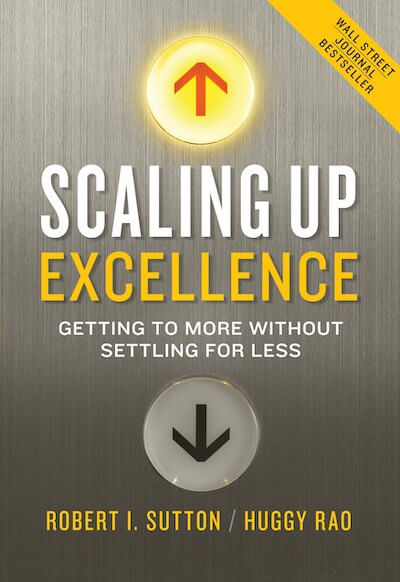
Scaling Up Excellence Book Summary
This Scaling Up Excellence Book Summary covers the key ideas, lessons, and takeaways in about 20 minutes.
Short Description:
Scaling Up Excellence shows how to grow organizations without losing quality.
Helps with these goals
Want the complete 20-minute summary?
- Full structured summary
- Video Summary
- Podcast Summary
- Key takeaways
- Exercises
- Quiz
- Highlights and notes
- Ask the book with AI
Want a Free Weekly Read?
Get a free summary every week straight to your mailbox.
Preview the Scaling Up Excellence book summary
Below is a preview of Sumizeit’s comprehensive human-written summary of Scaling Up Excellence by Robert I. Sutton. The full summary is 15-20 minutes long and covers the book’s key ideas in text, audio, visual, and video formats. Unlock the full 20 Minute Summary
There are so many good ideas in the world; So many booming businesses with excellent performance and products that are changing the world. But, how can we spread these behaviors and products to people in different areas? Or even, just these good practices into other parts of the workplace?
In “Scaling Up Excellence” Sutton and Rao help readers to understand the struggles in sharing replicated practices and behaviors with different people and in different places.
“Scaling is akin to running a long race where you don’t know the right path, often what seems like the right path turns out to be the wrong one, and you don’t know how long the race will last, where or how it will end, or where the finish line is located. Yet it is one of the fundamental challenges that every organization faces, whether it’s small or large, new or old, or somewhere in between.” - Robert I. Sutton & Huggy Rao
They discuss the steps it takes to successfully scaling a company. And, tells you exactly what will hinder the process.
With this information, backed by research, you will be able to tackle your own scaling challenges.
Scaling is Essential
Scaling is the practice of spreading and introducing superb performance to more people and places.
Scaling is often referred to as “the problem of more” because it is a challenge for leaders to spread these positive performances.
The act of scaling can come in many different forms. For example, it could mean opening a new coffee shop in a different city or it could be growing the number of company employees. Or, even improving productivity and lowering mistakes in the workplace.
“It means constantly seeking and implementing better ways of thinking and acting across old and new corners of the system.”- Robert I. Sutton & Huggy Rao
There are two parts to scaling:
These go hand-in-hand. So, the “problem of more” also is the “problem of better” for the leaders in charge.
Scaling requires companies to be innovative by always developing new strategies and organizational structures in the workplace.
There is no easy recipe to follow to successfully scale a workplace to excellence.
Be Persistent
When you are working on scaling your company, be prepared to be in it for the long-haul. Scaling takes time, effort, and most of all, persistence.
There will be a lot of unforeseen roadblocks and bumps along the way, but you must have the mental endurance to keep going or else your scaling efforts will fail.
Before you begin, you must have the right amount of resources and manpower to fight through the scaling process.
For example, Mark Zuckerburg, the founder of Facebook made sure that everyone on his team was fully on board with his vision of this new platform.
He made every single employee go through a six-week test that consisted of them working with a mentor and proving that they fully understood the vision of the company.
By spending the time to fully train and…
Want the complete 20-minute summary?
- Full structured summary
- Video Summary
- Podcast Summary
- Key takeaways
- Exercises
- Quiz
- Highlights and notes
- Ask the book with AI
Who should read Scaling Up Excellence?
Scaling Up Excellence is essential for business leaders, entrepreneurs, and managers who want to expand their operations while maintaining quality and excellence. Whether you're growing a startup, opening new locations, or expanding teams across departments, this book provides frameworks for anyone facing the challenge of spreading best practices across larger organizations.
Why does Scaling Up Excellence matter?
In today's fast-paced business environment, companies that can replicate excellence at scale gain competitive advantage and avoid the pitfalls of rapid growth. Scaling Up Excellence addresses the "problem of more"—how to maintain quality, culture, and performance as organizations expand—making it vital for leaders navigating growth challenges in any industry.
What are the key themes in Scaling Up Excellence?
- Replicating best practices while improving performance
- Balancing standardization with local adaptation
- Building accountability and team cohesion
- Eliminating toxic behaviors before scaling
- Strategic persistence through scaling challenges
- The role of diversity in spreading excellence
Want the complete 20-minute summary?
- Full structured summary
- Video Summary
- Podcast Summary
- Key takeaways
- Exercises
- Quiz
- Highlights and notes
- Ask the book with AI
How can you apply ideas from Scaling Up Excellence?
- Audit your current practices to identify which ones are excellence-worthy before scaling them across the organization
- Conduct a stakeholder analysis to understand how local cultures and contexts differ, then adapt core practices accordingly
- Implement a structured onboarding or training program that immerses new employees in your organization's vision and values
- Create accountability systems where team members monitor peers and feel empowered to address performance gaps collaboratively
- Establish metrics to track whether scaling efforts are simultaneously replicating best practices and improving overall performance
- Build cross-functional teams and communication channels that leverage diversity to spread excellence across departments and locations
- Identify and address toxic team members early, using clear performance standards and consequences to maintain cultural integrity
What common mistakes do readers make with Scaling Up Excellence?
- Scaling bad practices alongside good ones, assuming negative behaviors will disappear during expansion instead of actively eliminating them first
- Underestimating the time, resources, and persistence required for successful scaling and abandoning efforts prematurely when roadblocks appear
- Adding unnecessary complexity through redundant processes, excessive reporting, or too many roles before the organization's foundation is solid
- Treating scaling as a one-size-fits-all initiative without adapting to local contexts, cultures, and employee preferences across different regions or departments
Sumizeit Exercises Apply what you've learned
Turn ideas from Scaling Up Excellence into action with a short guided reflection: identify the biggest takeaway, connect it to your life, and commit to one step you can take in the next 24 hours.
What is the expert analysis of Scaling Up Excellence?
Overview
Scaling Up Excellence is a seminal work co-authored by Robert I. Sutton, a distinguished professor of management science at Stanford University, and Huggy Rao. Sutton’s academic rigor and practical insights into evidence-based management underpin this book, which addresses one of the most pervasive challenges in organizational leadership: how to effectively spread best practices and superior performance across diverse teams and locations. The book’s significance lies in its synthesis of empirical research and real-world case studies, offering a nuanced roadmap for leaders seeking to scale excellence without diluting quality or organizational culture.
Core Thesis
The central argument of Scaling Up Excellence is that scaling is fundamentally a complex, iterative process akin to running an uncertain, long-distance race. Success in scaling depends not merely on replication of best practices but also on continuous improvement and adaptation to local contexts. Sutton and Rao emphasize that scaling is simultaneously “the problem of more” and “the problem of better,” requiring leaders to balance standardization with local variation, persist through setbacks, and cultivate the right people and culture to sustain excellence. The authors argue that scaling is less about finding a fixed formula and more about embracing a mindset of persistence, adaptability, and collective responsibility.
Strengths
- Integrative Framework: The book excels in presenting a comprehensive framework that integrates behavioral, cultural, and structural dimensions of scaling, moving beyond simplistic replication models.
- Evidence-Based Approach: Sutton’s grounding in research lends credibility, while illustrative examples—from Facebook’s onboarding practices to McDonald’s local menu adaptations—make abstract concepts tangible.
- Practical Wisdom: The emphasis on persistence, accountability, and envisioning the future provides actionable guidance for leaders navigating the unpredictable terrain of organizational growth.
- Attention to Human Factors: The focus on people—building connections, fostering shared beliefs, and eliminating toxic influences—recognizes the centrality of human dynamics in scaling efforts.
Critiques & Counterarguments
- Potential Oversimplification: While the book acknowledges complexity, some readers may find the dichotomy of standardization versus local variation too binary, overlooking hybrid models where emergent practices evolve organically without clear boundaries.
- Limited Engagement with Contradictory Research: The authors primarily advocate for persistence and incremental scaling, but alternative theories from complexity science and adaptive leadership suggest that sometimes scaling requires radical pivots or even contraction to maintain excellence.
- Contextual Constraints Underexplored: The book’s examples predominantly come from technology and service sectors; scaling challenges in heavily regulated or resource-constrained environments may require different approaches not fully addressed here.
- Behavior vs. Belief Debate: The discussion on whether to change beliefs before behaviors or vice versa is presented as a choice, yet psychological and sociological research indicates that these processes are often reciprocal and context-dependent, complicating prescriptive advice.
- Risk of Cultural Homogenization: The emphasis on spreading “excellence” risks imposing dominant cultural norms that may marginalize local or minority practices, a critique aligned with postcolonial and organizational diversity scholarship.
Who Should Read This
Scaling Up Excellence is essential reading for senior executives, organizational development professionals, and entrepreneurs who grapple with the challenges of growth and replication in complex environments. It is particularly valuable for those who appreciate a research-informed yet pragmatic approach to leadership. Additionally, scholars and students of organizational behavior and management will find Sutton and Rao’s synthesis a rich resource for understanding the interplay between culture, strategy, and human dynamics in scaling. However, readers seeking a one-size-fits-all manual or those working in highly specialized or non-commercial sectors may need to supplement this book with more context-specific literature.
Frequently asked questions about the Scaling Up Excellence book summary
What is Scaling Up Excellence about?
Scaling Up Excellence by Robert I. Sutton and Huggy Rao is about the art and science of spreading excellent practices, behaviors, and performance across more people and places in an organization. The book provides research-backed frameworks for leaders facing the "problem of more"—how to grow while maintaining quality, culture, and excellence. It addresses both replicating best practices and improving performance simultaneously as organizations expand.
Who should read Scaling Up Excellence?
Scaling Up Excellence is ideal for business leaders, entrepreneurs, managers, and executives who are growing their organizations or expanding into new markets and departments. It's particularly valuable for anyone struggling to maintain excellence and culture during rapid expansion, franchise owners opening new locations, or leaders managing significant increases in team size. The book applies to organizations of any size navigating the complexities of sustainable growth.
What are the main takeaways from Scaling Up Excellence?
The main takeaways include: scaling requires both replicating best practices and improving performance; persistence and adequate resources are essential for success; leaders must balance standardization with local adaptation; the right people and accountability systems are critical; one toxic person can damage team productivity significantly; and deep connections and diversity help spread excellence naturally. Ultimately, Scaling Up Excellence emphasizes that successful growth demands strategic vision, strong team cohesion, and unwavering commitment to maintaining high standards.
How do you balance standardization and local variation when scaling?
Successful scaling requires identifying which core standards and values are non-negotiable across all locations or departments, then allowing flexibility in how those standards are implemented locally. For example, McDonald's maintains consistent operational quality standards globally while adapting menu items to local tastes and preferences. Leaders must consciously decide which practices are universal requirements and which can be customized to respect local cultures and contexts without compromising excellence.
Why is removing toxic employees important before scaling?
One toxic or underperforming employee can decrease team productivity by 30-40 percent by damaging morale and diverting focus away from work. When organizations scale, they amplify what already exists—both excellence and dysfunction. Removing negative influences before expanding ensures that as the company grows, it spreads excellence rather than spreading negativity, toxicity, or poor practices across the entire expanded organization.
What does it mean to move a thousand people forward a foot at a time?
This principle emphasizes that successful scaling focuses on moving large groups forward incrementally and collectively rather than trying to dramatically transform individual performance. Instead of concentrating resources on making one person exceptional, leaders should focus on advancing the entire team's capabilities gradually. This collective approach builds stronger, more cohesive organizations where everyone improves together rather than creating isolated high performers.
Should you target belief or behavior first when scaling?
Both approaches can work, but leaders must consciously choose which strategy aligns with their organization's culture. Some argue that changing beliefs first drives behavior change, while others find that changing behavior first leads to belief shifts. The key is understanding your organization's dynamics and deliberately selecting whether to motivate through belief or behavior, then executing that chosen strategy consistently throughout the scaling process.
About Sumizeit
Sumizeit is a profitable Scomy LLC company based in Miami, Florida. Our founders, Clemens Raemy and Weina Scott, are successful entrepreneurs with several exits. Sumizeit is a popular book summary app / micro learning app used by busy professionals and entrepreneurs with over 2,500 non-fiction book summaries and 10,000 podcast summaries in text, audio, visual, podcast, and video format. We also have stellar retention tools to make ideas stick - such as flashcards with spaced repetition, quizzes, streaks, highlighting and notes, daily challenges, riddles, mini-courses, meditation, and more. You won't only learn the idea, but also remember it. Over 90% of our users change their habits with Sumizeit.
Upgrade Now
Want the complete 20-minute summary?
- Full structured summary
- Video Summary
- Podcast Summary
- Key takeaways
- Exercises
- Quiz
- Highlights and notes
- Ask the book with AI
Here's why readers love Sumizeit
Join thousands of learners getting smarter every day
"Great experience. Detailed summaries. Loved the gamification feature. Makes learning fun. Good customer service. I recommend Sumizeit to anyone. You'll learn a lot."
"I always felt busy but still wanting to keep up with the book discussion in my friend group. This was a great supplement to help me keep reading the books I find fun while keeping up with important books."
"I love this website. Instead of scrolling social media, I find myself learning a lot. I use it everyday. I recommend this app for anyone who is too busy and wants to get up to speed with their favorite books."
Scaling Up Excellence Book Summary PDF
Looking for a Scaling Up Excellence Book Summary PDF you can save and revisit offline? Our Scaling Up Excellence Book Summary PDF captures the book’s core ideas in a clean, printable format — the key frameworks, takeaways, and structure without the fluff. Download the Scaling Up Excellence Book Summary PDF when you want a reference you can annotate, share with your team, or review on the go. Get your Scaling Up Excellence Book Summary PDF from the download page below.
Download Scaling Up Excellence Book Summary PDFPeople also liked these summaries
Readers who explored Scaling Up Excellence often enjoyed these titles next.



Want the complete 20-minute summary?
- Full structured summary
- Video Summary
- Podcast Summary
- Key takeaways
- Exercises
- Quiz
- Highlights and notes
- Ask the book with AI
Featured Book Titles
Popular Book Summaries at sumizeit, leading book summary app