


As an Amazon Associate, Sumizeit earns from qualifying purchases.
No Hard Feelings Book Summary
This No Hard Feelings Book Summary covers the key ideas, lessons, and takeaways in about 20 minutes.
Helps with these goals
Want the complete 20-minute summary?
- Full structured summary
- Video Summary
- Podcast Summary
- Audio summary
- Key takeaways
- Exercises
- Quiz
- Highlights and notes
- Ask the book with AI
What is in the No Hard Feelings book summary?
Below is a preview of Sumizeit’s expert-written summary of No Hard Feelings by Liz Fosslien. The full summary covers the book’s key ideas in text, audio, and video.
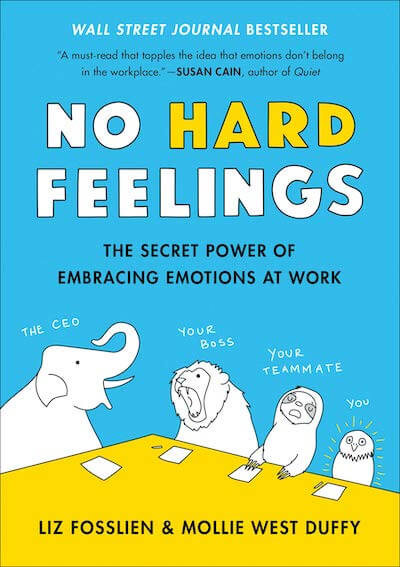
No Hard Feelings: The Secret Power of Embracing Emotions at Work is a useful guide to understand and manage emotions in the workplace. The workplace is an emotional minefield that requires careful navigation. Liz Fosslien and Molly Duffy give practical steps in a hilarious manner on how to avoid emotional burnout at the office and find a healthy work-life balance. The authors show how managing emotions at work is important in staying motivated.
Chapter 1: The Future is Emotional
Humans are emotional creatures by nature. At one time or the other, we all feel overwhelmed, frustrated, and insecure at work. Emotions will always be there- so it’s time you learned to deal with them.
However, most people choose avoidance and suppression in order to appear professional in the workplace. However, this often leads to anxiety and burnout
You have heard that Emotional Intelligence (EQ) is a good predictor of success in the workplace. EQ requires that professionals of the future learn from, and talk about emotions without becoming emotional.
Chapter 2: Health-Be less passionate about your job: Why taking a chill pill makes you healthier
How many times do you check your email at work? For most people, the average time is ten minutes? Being too passionate about work is unhealthy!
Your mood at home shouldn’t be influenced by your mood at the job.
What is the solution to the above problem? There are basically two options-take a holiday or be less passionate about the job (the second option is easier and cheaper!)
Chapter 3: Motivation--Inspire yourself
Most employees are not motivated in the workplace. The level of engagement is often low due to a lack of flexibility and creativity. What does this mean? Going to work for most people is a daily chore.
How do you get motivated and stay motivated? Finding a sense of purpose is your starting point. Reward yourself every time you feel you have accomplished a goal.
Connect with people at the workplace who are inspiring--tap into that uplifting, positive energy and get motivated
Chapter 4: Decision Making--Emotion is part of the equation: Why good decisions rely on examining your emotions
Most people believe that making decisions is a process that is unemotional. Well, that is not true. Emotions are always at work consciously or unconsciously
Since we can’t ignore our emotions, we ought to manage them. This form of emotional decision-making takes practice and involves embracing some emotions and ignoring others.
This means starting by considering what emotions we feel when making decisions. Are the emotions relevant or irrelevant to the decision at hand? For example, firing an employee when you are angry is likely to cloud your judgment.
Chapter 5: Teams-Psychological safety first: Why the how matters more than the who
In a team setting, junior staffers often feel too shy to express their true feelings. They fear making a fool of themselves before senior members. This is referred to as psychological safety--the ease of interacting freely without fear of embarrassment.
Why is…
Want the complete 20-minute summary?
- Full structured summary
- Video Summary
- Podcast Summary
- Audio summary
- Key takeaways
- Exercises
- Quiz
- Highlights and notes
- Ask the book with AI
Who should read No Hard Feelings?
No Hard Feelings is for anyone who experiences stress, burnout, or emotional tension at work—from individual contributors navigating office dynamics to managers building healthier teams. Whether you're struggling with work-life balance, finding it hard to stay motivated, or want to create a more emotionally intelligent workplace, this book offers practical guidance.
Why does No Hard Feelings matter?
In today's high-pressure work environment, ignoring emotions leads to burnout and decreased productivity, yet many professionals still suppress their feelings to appear professional. No Hard Feelings by Liz Fosslien reframes emotional awareness as a strength rather than a weakness, showing how emotional intelligence directly impacts decision-making, team performance, and overall workplace wellbeing. As remote and hybrid work continues to reshape how we communicate, understanding how to manage emotions—rather than avoid them—has become essential for sustainable career success.
What are the key themes in No Hard Feelings?
- Emotional intelligence is a critical workplace skill
- Suppressing emotions leads to burnout and anxiety
- Psychological safety enables high-performing teams
- Leaders should model selective vulnerability
- Emotions inform better decision-making when managed consciously
- Small cultural actions create lasting emotional shifts
- Work-life boundaries protect mental health
What are the key lessons from the No Hard Feelings book summary?
Emotions at work are inevitable, not unprofessional
Acknowledging that feelings exist in the workplace—rather than pretending they don't—is the first step toward managing them effectively and avoiding emotional burnout.
Emotional avoidance backfires
Suppressing emotions to appear professional often leads to anxiety, overwhelm, and burnout; facing emotions head-on is healthier than pretending they don't exist.
Emotional Intelligence (EQ) predicts workplace success
EQ—the ability to understand, discuss, and learn from emotions without becoming overwhelmed by them—is as important as technical skills for career advancement.
Less passion about work means better health
Being overly invested in your job bleeds into personal life and damages wellbeing; maintaining healthy emotional boundaries between work and home improves overall health.
Purpose fuels sustainable motivation
Motivation doesn't come from grinding harder; it emerges from finding meaningful purpose in your work and celebrating incremental wins.
Emotions are data in decision-making
Rather than trying to eliminate emotion from decisions, successful leaders examine which emotions are relevant to the situation and which are clouding judgment.
Distinguish relevant emotions from irrelevant ones
A key skill is learning to identify whether your emotional reaction serves the decision at hand or is a distraction that could lead to poor choices.
Psychological safety is foundational for team excellence
Teams perform best when members feel safe expressing ideas, concerns, and even vulnerability without fear of embarrassment or retribution.
Team leaders set the emotional tone
Creating psychological safety starts with the leader; simple practices like using humor, asking unusual questions, and reducing pressure help team members relax and contribute fully.
You can voice emotions without becoming emotional
Learning to express frustration, concern, or anger calmly—like proofreading an email before sending—prevents miscommunication and preserves relationships.
Emotional expression requires practice
Articulating feelings without volatility is a skill that improves with intention and repeated effort; it's as learnable as any professional competency.
Small gestures create measurable cultural shifts
Tiny actions—like an emoji in a message or a walking conversation instead of a sit-down meeting—signal emotional awareness and reshape workplace norms.
Tailor culture to different personality types
Introverts, extroverts, and others have different emotional needs; inclusive leaders create options that allow everyone to participate authentically.
Leaders should show selective vulnerability
Admitting that you have bad days and imperfections as a leader humanizes you and gives permission for others to be imperfect too, reducing emotional tension.
Perfect composure is unattainable and counterproductive
The myth of always 'keeping it together' sets an impossible standard that stresses teams; authenticity builds trust more effectively than a facade.
Emotional culture cascades from leadership
How leaders handle their own emotions, communicate about challenges, and respond to others' feelings sets the template for the entire organization.
Connecting with motivated colleagues boosts your own energy
Surrounding yourself with inspiring, positive people creates uplifting feedback loops that naturally increase your motivation and resilience.
Reward incremental progress
Breaking goals into smaller wins and celebrating them maintains motivation and prevents the overwhelm that comes from focusing only on distant targets.
Email communication benefits from emotional proofreading
Just as you review an email for tone before sending, you can monitor your emotional state during difficult conversations to ensure you're heard clearly.
Emotional awareness improves work-life balance
Understanding and managing emotions at work prevents them from invading your personal time, allowing genuine rest and recovery outside office hours.
Want the complete 20-minute summary?
- Full structured summary
- Video Summary
- Podcast Summary
- Audio summary
- Key takeaways
- Exercises
- Quiz
- Highlights and notes
- Ask the book with AI
How can you apply ideas from No Hard Feelings?
- Use walking meetings with introverted colleagues to help them loosen up and participate more freely
- Before making high-stakes decisions or difficult conversations, pause and identify which emotions are relevant versus distracting
- Create exit strategies for team members in meetings—giving permission to step out without embarrassment signals psychological safety
- Start team meetings with light, absurd questions to build trust before diving into serious topics
- Monitor your email tone by 'proofreading' your emotions before hitting send or speaking in tense conversations
- Intentionally share a non-catastrophic weakness or bad day with your team to normalize imperfection and reduce emotional pressure
- Set clear boundaries around work email and messaging to protect your evening and weekend mood from work stress
- Identify and celebrate colleagues with inspiring energy, then spend intentional time around them to boost your own motivation
What common mistakes do readers make with No Hard Feelings?
- Assuming professionalism requires suppressing all emotions, which backfires into burnout and anxiety
- Making important decisions while angry, upset, or highly stressed without pausing to consider whether the emotion is clouding judgment
- Expecting yourself or others to maintain perfect emotional composure, which creates impossible standards and erodes trust
- Overlooking small cultural actions and assuming big systemic changes are needed, when often small gestures (like emojis or walking meetings) shift norms
- As a leader, projecting a persona of 'having it all together' rather than showing selective vulnerability, which disconnects you from stressed employees
Sumizeit Exercises Apply what you've learned
Turn ideas from No Hard Feelings into action with a short guided reflection: identify the biggest takeaway, connect it to your life, and commit to one step you can take in the next 24 hours.
What is the expert analysis of No Hard Feelings?
Overview
No Hard Feelings: The Secret Power of Embracing Emotions at Work is a contemporary exploration of emotional intelligence tailored specifically for the workplace. Co-authored by Liz Fosslien and Mollie West Duffy, both of whom bring a unique blend of design thinking, organizational psychology, and practical consulting experience, the book addresses a critical yet often overlooked dimension of professional life: the management and expression of emotions. Fosslien’s background in economics and illustration combined with Duffy’s expertise in organizational design and research lends the work both analytical rigor and accessible creativity. This book stands out in the crowded field of workplace self-help by marrying humor with actionable insights, making emotional literacy a pragmatic tool rather than an abstract ideal.
Core Thesis
The central argument of No Hard Feelings is that emotions are an inescapable and integral part of the workplace experience, and rather than suppressing or ignoring them, professionals should learn to recognize, manage, and strategically express their emotions to foster healthier, more productive work environments. The authors contend that emotional intelligence—understood as the ability to navigate one’s own feelings and those of others—is essential for motivation, decision-making, teamwork, communication, and leadership. They advocate for a cultural shift that embraces emotional authenticity without sacrificing professionalism, promoting psychological safety and selective vulnerability as cornerstones of effective organizational dynamics.
Strengths
- Practicality and Accessibility: The book excels in translating complex psychological concepts into digestible, actionable advice supported by relatable anecdotes and humorous illustrations, which enhance reader engagement and retention.
- Holistic Coverage: By addressing a broad spectrum of workplace scenarios—from individual motivation to team dynamics and leadership—the book provides a comprehensive framework for understanding emotional intelligence in context.
- Emphasis on Psychological Safety: Highlighting the importance of creating environments where employees feel safe to express emotions without fear of judgment is a timely and well-supported insight aligned with contemporary organizational research.
- Balanced View on Passion and Detachment: The nuanced discussion on tempering excessive passion to avoid burnout challenges prevailing cultural narratives that valorize relentless work ethic, advocating for sustainable engagement.
- Integration of Emotional Decision-Making: The recognition that emotions are integral, not antithetical, to rational decision-making reflects an advanced understanding of human cognition often missing in traditional business literature.
Critiques & Counterarguments
- Oversimplification of Emotional Complexity: While the book’s accessible style is a strength, it occasionally reduces the multifaceted nature of emotions and their interplay with organizational culture to simplified prescriptions, potentially underestimating the challenges of implementation in diverse workplaces.
- Limited Empirical Evidence: The arguments rely heavily on anecdotal examples and popular psychology rather than robust empirical studies, which may weaken the book’s authority among academic or skeptical readers.
- Potential Cultural Bias: The recommendations presume a Western, corporate context where individual expression is valued; in more hierarchical or collectivist cultures, the advocated emotional openness might clash with prevailing norms and could be counterproductive.
- Competing Perspectives on Emotional Expression: Some organizational behavior scholars argue that emotional regulation rather than expression is key to professionalism, cautioning that too much vulnerability can undermine authority and decision-making clarity—this tension is not fully explored.
- Real-World Constraints: The ideal of psychological safety and selective vulnerability may be difficult to achieve in high-pressure or resource-constrained environments where systemic issues (e.g., job insecurity, toxic leadership) dominate, limiting the applicability of the book’s strategies.
Who Should Read This
No Hard Feelings is ideally suited for mid-level professionals, team leaders, HR practitioners, and organizational designers who seek to cultivate emotionally intelligent workplaces. It offers valuable insights for readers interested in the intersection of psychology and business, especially those grappling with burnout, low motivation, or communication challenges. Additionally, leaders aiming to foster inclusive cultures that prioritize psychological safety will find practical guidance here. However, readers seeking rigorous academic analysis or culturally universal prescriptions might need to supplement this book with more specialized literature.
Frequently asked questions about the No Hard Feelings book summary
What is No Hard Feelings about?
No Hard Feelings: The Secret Power of Embracing Emotions at Work by Liz Fosslien is a practical guide to understanding, acknowledging, and managing emotions in the workplace rather than suppressing them. The book shows how emotional intelligence—not emotional avoidance—leads to better decision-making, stronger teams, improved motivation, and reduced burnout.
Who should read No Hard Feelings?
No Hard Feelings is ideal for professionals at any career stage who experience workplace stress, anyone struggling with work-life balance, and managers or leaders wanting to build healthier, more psychologically safe teams. If you've ever felt overwhelmed, unmotivated, or isolated at work, this book offers practical strategies to improve your emotional resilience and workplace relationships.
What are the main takeaways from No Hard Feelings?
Key takeaways include: emotions are inevitable at work and should be managed, not suppressed; emotional intelligence is as critical as technical skills; psychological safety and selective vulnerability from leaders enable high-performing teams; emotions are data that inform better decisions when you pause to examine them; and small cultural actions create measurable shifts in workplace wellbeing. The book emphasizes that acknowledging and navigating emotions improves both productivity and personal health.
How can I apply No Hard Feelings to improve my team's performance?
Create psychological safety by starting meetings with light, trust-building questions; model selective vulnerability by admitting your imperfect days; design your culture around different personality types (e.g., walking meetings for introverts); and encourage team members to voice emotions calmly rather than suppress them. These small actions signal that emotional awareness is valued and enable people to contribute their best work.
Does No Hard Feelings address decision-making and emotions?
Yes, the book emphasizes that emotions always influence decisions, whether consciously or not. Rather than trying to make purely logical decisions, effective leaders learn to distinguish which emotions are relevant to the situation versus which ones are clouding judgment—like noticing when anger might make you fire someone hastily rather than thoughtfully.
How does No Hard Feelings help with burnout and work-life balance?
Fosslien argues that being overly passionate about work and checking email constantly bleeds work stress into your personal life, damaging your mood and health. The book recommends setting emotional boundaries—being less attached to work outcomes while maintaining focus—so your home life remains separate and restorative. This prevents the spiral of suppressed emotions turning into burnout.
What does No Hard Feelings say about motivation at work?
The book connects low motivation to lack of flexibility, creativity, and purpose. It recommends finding meaningful purpose in your work, celebrating incremental wins, and surrounding yourself with inspiring, positive colleagues whose energy lifts you up. Motivation isn't sustained through grinding harder but through connection, purpose, and emotional renewal.
Can I improve my communication skills by reading No Hard Feelings?
Yes, the book teaches you to voice emotions and concerns without becoming volatile—a skill Fosslien compares to proofreading an email before sending. By learning to express frustration calmly and examining your emotions before difficult conversations, you communicate more clearly and preserve relationships, even during conflict.
About Sumizeit
Sumizeit is a profitable Scomy LLC company based in Miami, Florida. It has been helping readers learn from nonfiction books for 7 years with expert-written summaries in text, audio, podcast, and video.
Want the complete 20-minute summary?
- Full structured summary
- Video Summary
- Podcast Summary
- Audio summary
- Key takeaways
- Exercises
- Quiz
- Highlights and notes
- Ask the book with AI
Here's why readers love Sumizeit
Join thousands of learners getting smarter every day
"Great experience. Detailed summaries. Loved the gamification feature. Makes learning fun. Good customer service. I recommend Sumizeit to anyone. You'll learn a lot."
"I always felt busy but still wanting to keep up with the book discussion in my friend group. This was a great supplement to help me keep reading the books I find fun while keeping up with important books."
"I love this website. Instead of scrolling social media, I find myself learning a lot. I use it everyday. I recommend this app for anyone who is too busy and wants to get up to speed with their favorite books."
No Hard Feelings Book Summary PDF
Looking for a No Hard Feelings Book Summary PDF you can save and revisit offline? Our No Hard Feelings Book Summary PDF captures the book’s core ideas in a clean, printable format — the key frameworks, takeaways, and structure without the fluff. Download the No Hard Feelings Book Summary PDF when you want a reference you can annotate, share with your team, or review on the go. Get your No Hard Feelings Book Summary PDF from the download page below.
Download No Hard Feelings Book Summary PDFPeople also liked these summaries
Readers who explored No Hard Feelings often enjoyed these titles next.



Want the complete 20-minute summary?
- Full structured summary
- Video Summary
- Podcast Summary
- Audio summary
- Key takeaways
- Exercises
- Quiz
- Highlights and notes
- Ask the book with AI
Featured Book Titles
Popular Book Summaries at sumizeit, leading book summary app
