

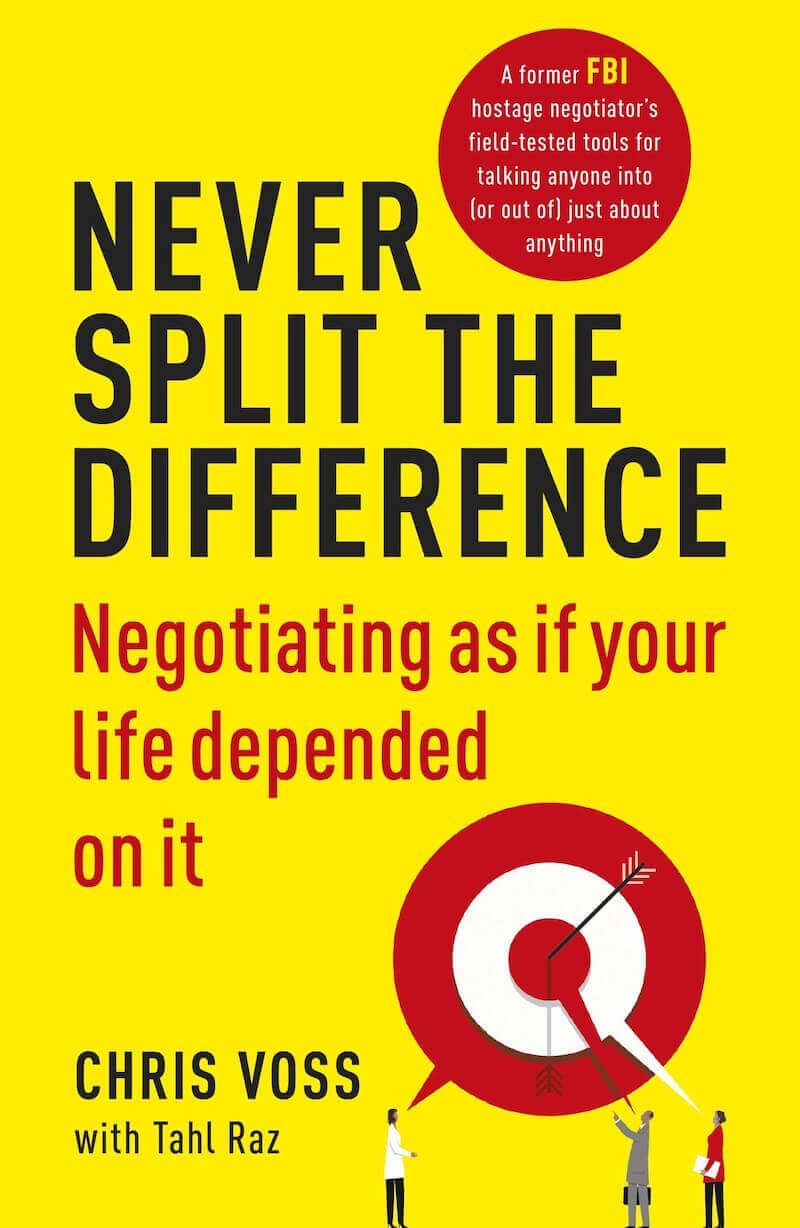
"Never Split the Difference" by Chris Voss, a former FBI hostage negotiator, provides strategies and techniques for high-stakes negotiations. Voss emphasizes the importance of empathy and understanding the counterpart's perspective to gain an advantage. He introduces concepts like "tactical empathy," active listening, and the use of calibrated questions to guide conversations and uncover hidden information.
The book challenges conventional negotiation wisdom, suggesting that compromise isn’t always the best outcome. Instead, Voss advocates for understanding and influencing emotions to reach a mutually beneficial agreement, making it a powerful guide for negotiations in both personal and professional settings.
Helps with these goals
As an Amazon Associate, Sumizeit earns from qualifying purchases.
What Will You Learn?
Who Is This For?
Never Split the Difference: Negotiating as If Your Life Depended on It by Christopher Voss and Tahl Raz is a masterclass in high-stakes negotiation, based on Voss’s experiences as a former FBI hostage negotiator. First published in 2016, the book distills the powerful techniques he used in crisis situations, such as international kidnappings and hostage situations, into actionable strategies that can be applied to business, personal, and everyday negotiations. Voss’s career at the FBI exposed him to some of the most intense, high-pressure negotiation situations, and he became known for his ability to extract information from hostage-takers and resolve tense situations.
Voss’s approach challenges traditional negotiation tactics, such as compromising or aiming for win-win outcomes, arguing instead that these strategies often lead to suboptimal results. Through practical techniques, such as tactical empathy, mirroring, labeling, and the “accusation audit,” he offers readers a toolkit for securing better deals, resolving conflicts, and influencing others effectively. Co-author Tahl Raz, a journalist, helps articulate Voss's lessons by providing real-world examples and deep insights into how these negotiation principles can be applied in everyday situations. The book has been highly praised for its accessible, yet effective, negotiation advice, offering a transformative shift in the way readers approach conflict and collaboration.
One of the key concepts introduced by Christopher Voss in Never Split the Difference is tactical empathy. Voss emphasizes that understanding the emotions, thoughts, and perspectives of the other party in a negotiation is not just a helpful tool but a crucial component of success. Tactical empathy involves not only listening to what the other person says but also picking up on their emotional cues, motivations, and concerns, even those they may not express openly. This strategy allows negotiators to align with the counterpart’s psychological state and influence their decision-making.
Voss contrasts tactical empathy with sympathy. While sympathy can create a bond based on shared emotions, tactical empathy is strategic; it’s about understanding the other party’s position to gain leverage, not necessarily aligning with their emotions. In high-stakes situations, such as hostage negotiations, Voss used tactical empathy to uncover the emotional drivers of the criminals, which often led to better outcomes.
By acknowledging the other party's perspective, negotiators can create trust and defuse tension. One of the practical techniques Voss teaches is mirroring—repeating the last few words the other person said in a questioning tone. This simple tactic encourages the counterpart to expand on their thoughts and opens up further opportunities for understanding. By using tactical empathy, negotiators can improve their ability to manage conflict, reduce resistance, and create a more productive dialogue.
Voss discusses the importance of hearing “no” in negotiations, an often misunderstood aspect of successful bargaining. Many traditional negotiation strategies focus on getting to “yes” as quickly as possible, believing it is a sign of progress. However, Voss argues that “yes” can be misleading, and that true progress is often made after a “no.” In hostage negotiations, the word “no” is frequently the first real opportunity to establish the boundaries of the discussion and is often a sign of the other party’s discomfort or hesitation.
Voss suggests that “no” provides a sense of control to the counterpart, which reduces their defensiveness and opens the door for more genuine dialogue. Instead of fearing rejection or resistance, negotiators should embrace the “no” as an opportunity to gather more information, reframe the conversation, and steer the discussion toward a solution. In his FBI experience, Voss often intentionally used statements designed to provoke a “no” response, such as asking, “Would it be out of the question for you to help me?” This approach allows the negotiator to test the waters and find areas where further negotiation can occur.
Furthermore, Voss introduces the concept of the “accusation audit,” a technique where the negotiator anticipates and addresses potential objections the counterpart might have. This allows the negotiator to create a safe space where the other party feels heard and understood, making them more likely to engage in a productive negotiation.
In Never Split the Difference, Voss outlines two highly effective techniques for building rapport and gaining the upper hand in negotiations: mirroring and labeling. Both of these tactics are based on the principles of active listening and psychological manipulation, designed to get the other party to reveal more information while simultaneously building trust and rapport.
Mirroring involves subtly mimicking the other person’s words or body language to create a sense of connection. Voss explains that when negotiators mirror the words or phrases used by the counterpart, it can create a psychological bond, making the other party feel understood and more likely to open up. This technique often leads the other person to elaborate on their thoughts or feelings, providing valuable insights that the negotiator can use to shape the conversation.
Labeling, on the other hand, involves identifying and naming the emotions or feelings that the counterpart may be experiencing. By stating phrases such as, “It seems like you’re feeling frustrated” or “It sounds like you’re uncertain,” the negotiator helps the other person feel validated and acknowledged. This emotional validation can lower defenses and pave the way for a more cooperative discussion. Labeling also works as a method of deflection: when a counterpart is angered or defensive, acknowledging their emotions helps to diffuse tension, making them feel heard.
Both mirroring and labeling are powerful tools for enhancing the emotional dynamics of a negotiation, enabling the negotiator to guide the conversation with empathy and precision.
In Never Split the Difference, Voss introduces the concept of Black Swans—unexpected pieces of information that can dramatically change the course of a negotiation. Black Swans are the unknown unknowns, those critical details that, once uncovered, have the power to shift the dynamics of the entire discussion. Voss highlights that many negotiations fail because the participants focus on only the information they already know, ignoring the possibility that a game-changing detail could be hiding just beneath the surface.
Voss emphasizes that uncovering Black Swans requires a deep commitment to listening and asking the right questions. It involves paying attention to non-verbal cues, unspoken tensions, and inconsistencies in the other party's statements. The best negotiators know that there is always something that hasn't been revealed, and they strive to uncover these hidden factors to achieve breakthroughs in difficult negotiations.
In practical terms, Voss recommends active listening and tactical questioning as strategies to reveal Black Swans. He uses examples from his own FBI hostage negotiations, where key pieces of information—from the kidnappers' fears to their emotional triggers—were uncovered only after painstaking, empathetic questioning. Voss argues that the best negotiators are not those who can win through sheer force of logic, but those who are adept at discovering the hidden forces at play that can lead to a successful deal or resolution.
The idea of Black Swans reshapes how negotiators approach every situation, encouraging them to view every conversation as an opportunity to uncover vital, game-changing information.
In Never Split the Difference, Voss introduces the technique of creating the illusion of control, which allows negotiators to maintain influence while making the counterpart feel empowered. This tactic is rooted in the principle of reciprocity and is designed to guide the other party toward a solution without appearing coercive.
Voss explains that people are more likely to comply with requests when they feel that they have control over the situation. By offering the counterpart a sense of autonomy, negotiators can lead them to a favorable outcome without exerting direct pressure. One way to create the illusion of control is by using calibrated questions—open-ended questions that require thoughtful responses, such as “How do you propose we move forward?” or “What’s the best way for us to solve this problem together?”
These questions prompt the other party to think critically about the situation and propose solutions, which gives them the illusion that they are in control. In reality, the negotiator can steer the conversation toward their desired outcome by framing the options and guiding the dialogue. This technique is especially useful in high-stakes negotiations where resistance is likely.
Creating the illusion of control allows for collaboration while maintaining the upper hand. It fosters a sense of partnership, which can break down barriers and lead to more successful and amicable resolutions.
The main takeaway from Never Split the Difference is that successful negotiation is not about compromise or finding a middle ground, but about understanding human psychology and using emotional intelligence to guide conversations towards mutually beneficial outcomes. Christopher Voss emphasizes the importance of tactical empathy, the ability to understand and influence the emotions and motivations of the other party. This is a departure from traditional negotiation theories, which often prioritize logical reasoning over emotional understanding. Voss argues that people are driven by emotions, even in the most rational decision-making processes, and effective negotiators must tap into this emotional dynamic to succeed.
Voss also introduces powerful techniques such as mirroring, labeling, tactical questioning, and creating the illusion of control, all of which are designed to elicit information, defuse conflict, and influence outcomes without appearing confrontational. The concept of Black Swans—unexpected pieces of crucial information—reminds negotiators that there are always hidden factors that can transform the negotiation, and that the best negotiators are those who listen carefully and ask the right questions to uncover these insights.
Christopher Voss is a former FBI lead international kidnapping negotiator with over two decades of experience in high-stakes negotiations. He joined the FBI in 1992 and served in numerous critical operations, including leading the Crisis Negotiation Unit. After retiring, he founded The Black Swan Group, a consultancy firm that applies negotiation techniques to business and personal scenarios.
Tahl Raz is an award-winning journalist, author, and expert in business, leadership, and communication. With a talent for transforming complex ideas into engaging narratives, Raz has co-authored several bestselling books. His collaboration with Voss combines practical negotiation strategies with compelling real-life anecdotes, making advanced negotiation accessible to a broad audience.
Looking for a Never Split the Difference Book Summary PDF you can save and revisit offline? Our Never Split the Difference Book Summary PDF captures the book’s core ideas in a clean, printable format — the key frameworks, takeaways, and structure without the fluff. Download the Never Split the Difference Book Summary PDF when you want a reference you can annotate, share with your team, or review on the go. Get your Never Split the Difference Book Summary PDF from the download page below.
Download Never Split the Difference Book Summary PDFGet full access to 2,500+ book summaries with audio and video
Start Free Trial →