


Prefer the print book? Buy on Amazon
As an Amazon Associate, Sumizeit earns from qualifying purchases.
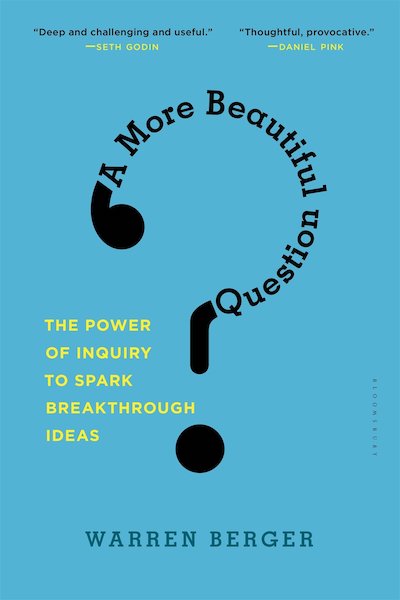
A More Beautiful Question Book Summary
This A More Beautiful Question Book Summary covers the key ideas, lessons, and takeaways in about 20 minutes.
Short Description:
A More Beautiful Question shows how asking the right questions sparks innovation.
The book draws on examples from successful innovators like Steve Jobs and the founders of Airbnb, emphasizing the importance of "Why," "What if," and "How" questions. Berger provides practical strategies for cultivating a questioning mindset, overcoming fear of failure, and fostering a culture of inquiry in organizations. Ultimately, it encourages readers to use questions as a tool to drive progress and explore uncharted possibilities.
Helps with these goals
Want a Free Weekly Read?
Get a free summary every week straight to your mailbox.
Preview the A More Beautiful Question book summary
Below is a preview of Sumizeit’s comprehensive human-written summary of A More Beautiful Question by Warren Berger. The full summary is 15-20 minutes long and covers the book’s key ideas in text, audio, visual, and video formats. Unlock the full 20 Minute Summary
Warren Berger, the writer of “A More Beautiful Question: The Power of Inquiry to Spark Breakthrough Ideas,” decided to interview some of the world’s leading innovators.
What he discovered was that they were all exceptionally good at asking the right questions.
This makes sense as geniuses such as Einstein and Socrates stumbled upon their greatest discoveries because of their ability to ask questions.
We also know that top leaders in the market succeed because of their curiosity and innovations which help them beat out their competition.
“You don’t learn unless you question.”- Warren Berger
By asking questions, we can embrace change to become adaptable and flexible which helps us to move forward as strong leaders.
In these insights, you will learn how to ask the right questions.
Inquiry Has Power
In 1976, Van Phillips, a man who had recently lost one of his legs in a tragic boating accident, asked the question “If they can put a man on the moon, why can’t they make a decent foot?”
This simple question propelled Phillips to dig deeper. Phillips enrolled in a prosthetics program at Northwestern University. Then, he spent ten years developing and perfecting a new design for an artificial limb.
After every failed design, he would ask more questions in order to keep improving the limb.
The curiosity for the answers to his questions is what pushed him to keep going. It was what kept him perfecting the artificial limb design.
The question “why” is an important one. It takes note of the issue at hand, promotes a challenge, and holds context.
Reed Hastings, the founder of Netflix, asked why he had to pay late fees when he brought a movie back to Blockbuster. This is an example of a top-leader getting sick of the old way and asking “why?” in the hopes of finding a new way.
However, you can’t just ask “why?” You must also take action.
People who take action usually follow this formula:
This can be called the “why, what if, and how sequence.” It’s a logical way to find a solution.
After Phillips asked “why?”, he started asking “what if?” That’s when he began finding innovative solutions to the problems he was having with his designs.
Phillips began studying springboard motion and animal anatomy to help spark some new ideas for improvement.
With this knowledge, Phillips made hundreds of designs and finally created the Flex-foot. This led to many more inventions. Without Phillips, amputees would not be climbing Mt.Everest or competing in the Olympics.
Asking the right questions can lead a person to amazing innovations, but we don’t all naturally have this inclination.
Why Do We Stop Asking Questions?
Children, naturally, ask a lot of questions. Between the ages of two and five, when the brain is rapidly developing, studies show a child asks approximately 40,000 questions.
After the age of five, the number of questions a child asks decreases. And from there it continues to decline.
“Don’t just teach your children to read.
Want the complete 20-minute summary?
- Full structured summary
- Video Summary
- Podcast Summary
- Audio summary
- Key takeaways
- Exercises
- Quiz
- Highlights and notes
- Ask the book with AI
Who should read A More Beautiful Question?
A More Beautiful Question is for innovators, business leaders, educators, and anyone seeking to solve problems more creatively. Whether you're stuck in your career, leading a team, or simply want to unlock your creative potential, this book teaches you how the right questions can transform your thinking and lead to breakthrough ideas.
Why does A More Beautiful Question matter?
In a rapidly changing world, the ability to ask powerful questions has become a competitive advantage. Warren Berger's research shows that the world's greatest innovators and leaders—from Steve Jobs to Reed Hastings—succeed because they question assumptions rather than accept the status quo. Today's complex challenges require curiosity-driven problem-solving, making this timely wisdom essential for anyone navigating uncertainty.
What are the key themes in A More Beautiful Question?
- The power of inquiry to spark innovation and breakthrough thinking
- The why-what if-how sequence as a framework for problem-solving
- How education and organizational culture suppress natural curiosity
- Adopting a beginner's mind to overcome expert assumptions
- Mission-driven questioning in business and personal life
- Collaborative inquiry as a tool for navigating complexity
How can you apply ideas from A More Beautiful Question?
- Use the why-what if-how framework to approach a current problem at work or in your personal life, moving systematically from problem identification to brainstorming to implementation
- Adopt a beginner's mind when facing familiar challenges by deliberately setting aside your expertise and asking what you would do if you were starting fresh
- Implement a structured questioning program in your organization or team, similar to Google's TGIF, where employees can submit and vote on questions for leadership
- Practice slowing down and unplugging regularly to reflect on life's bigger questions and clarify your personal mission without the noise of daily distractions
- Teach children and team members to question assumptions by modeling curiosity yourself and responding positively to their questions rather than seeking quick answers
- When facing fear of failure, reframe it with the question If I fail, how do I come back from that? to build resilience and persistence
- Document the five critical thinking skills—evidence, viewpoint, connection, conjecture, and relevance—and apply them to decisions and problems you face
What common mistakes do readers make with A More Beautiful Question?
- Asking questions without taking action—inquiry must be paired with experimentation and iteration to yield results
- Relying only on expert knowledge and existing assumptions rather than adopting a beginner's mind, which limits creative possibilities
- Creating organizational hierarchies that discourage employees from asking questions, suppressing the diversity of thought needed to solve complex problems
- Failing to slow down and reflect before jumping to answers, missing the deeper insight that a more beautiful question might reveal
Sumizeit Exercises Apply what you've learned
Turn ideas from A More Beautiful Question into action with a short guided reflection: identify the biggest takeaway, connect it to your life, and commit to one step you can take in the next 24 hours.
What is the expert analysis of A More Beautiful Question?
Overview
A More Beautiful Question: The Power of Inquiry to Spark Breakthrough Ideas is authored by Warren Berger, an accomplished American journalist and editor known for his insightful explorations into creativity and innovation. Berger’s extensive background in journalism and his focus on the art of questioning position him uniquely to investigate how inquiry fuels progress across disciplines. This book is significant because it elevates the act of questioning from a mere educational tool to a fundamental driver of innovation, leadership, and personal growth, drawing on interviews with leading innovators and historical examples to illustrate its points.
Core Thesis
Berger’s central argument is that the ability to ask “beautiful questions” — those that are ambitious yet actionable — is a critical catalyst for breakthrough ideas and meaningful change. He posits that inquiry follows a deliberate sequence of “why,” “what if,” and “how” questions, which together foster problem identification, creative ideation, and practical implementation. The book underscores that questioning is not innate in adults but must be cultivated, as it is essential for adaptability in business, education, and life. Berger advocates for a cultural shift that encourages curiosity and collaborative questioning to unlock innovation and solve complex problems.
Strengths
- Compelling Use of Narrative: Berger effectively employs vivid real-world case studies—from Van Phillips’ prosthetic innovations to Netflix’s founding—to animate his thesis, making abstract concepts tangible and relatable.
- Practical Framework: The “why, what if, how” sequence provides readers with a clear, actionable methodology for harnessing questioning as a creative tool, bridging theory and practice.
- Interdisciplinary Reach: The book draws from psychology, education, business, and design, demonstrating the universal applicability of inquiry across domains.
- Focus on Education and Leadership: By highlighting how questioning declines in childhood due to systemic factors, Berger prompts reflection on educational reform and leadership development.
- Encouragement of a Beginner’s Mindset: The emphasis on shedding assumptions to foster openness aligns with contemporary cognitive science insights about creativity and learning.
Critiques & Counterarguments
- Overemphasis on Questioning as a Panacea: While questioning is undeniably valuable, the book sometimes implies it as a near-universal solution, underplaying other factors such as expertise, resources, and serendipity that also contribute to innovation.
- Limited Engagement with Cognitive and Social Barriers: Berger acknowledges educational constraints but offers limited analysis of deeper psychological or cultural impediments to inquiry, such as confirmation bias or power dynamics in organizations.
- Potential Romanticization of Curiosity: The narrative occasionally idealizes questioning without sufficiently addressing situations where excessive questioning can lead to analysis paralysis or decision fatigue.
- Competing Research on Expertise and Creativity: Some cognitive scientists argue that deep domain expertise, rather than a beginner’s mindset alone, is crucial for breakthrough innovation, suggesting a more nuanced interplay than Berger’s framing.
- Real-World Organizational Resistance: Despite advocating for questioning in business, entrenched hierarchical cultures and risk aversion often stifle inquiry, a challenge that the book acknowledges but does not fully resolve.
Who Should Read This
This book is ideal for innovators, entrepreneurs, educators, and leaders who seek to cultivate a culture of curiosity and creative problem-solving. It will also resonate with readers interested in personal development and the psychology of creativity, offering practical strategies to rekindle their questioning instincts. Academics and professionals in fields requiring adaptive thinking will find Berger’s insights a valuable complement to their expertise. However, those looking for a rigorous academic treatise on inquiry may find the book’s journalistic style more inspirational than exhaustive.
Frequently asked questions about the A More Beautiful Question book summary
What is A More Beautiful Question about?
A More Beautiful Question by Warren Berger explores how the world's greatest innovators and leaders succeed by asking powerful questions rather than accepting the status quo. The book teaches a practical framework—why, what if, and how—for using inquiry to solve problems, spark innovation, and create meaningful change in business and life.
Who should read A More Beautiful Question?
This book is ideal for business leaders, innovators, educators, and anyone seeking to think more creatively and solve problems more effectively. Whether you're leading a team, starting a venture, teaching students, or simply want to unlock your creative potential, the book's insights on questioning will help you approach challenges with fresh perspective and curiosity.
What are the main takeaways from A More Beautiful Question?
The main takeaways include: (1) Follow the why-what if-how framework to move from identifying problems to brainstorming to taking action, (2) Adopt a beginner's mind to overcome expert assumptions and see new possibilities, (3) Encourage questioning in education and organizational culture rather than suppressing it, and (4) Pair inquiry with action—questions alone don't create innovation without experimentation and persistence.
What is the why-what if-how sequence?
The why-what if-how sequence is a three-stage framework for solving problems and generating innovation. First, ask why to identify and understand the problem, then ask what if to brainstorm creative solutions, and finally ask how to take concrete action and test your ideas. This logical progression transforms curiosity into tangible results.
Why do we stop asking questions as we grow up?
According to Berger, children naturally ask about 40,000 questions between ages two and five, but this curiosity declines over time largely due to educational systems that prioritize compliance and listening over inquiry. As we age, we also become self-conscious about asking questions in front of peers and authority figures, further suppressing our natural curiosity.
How can businesses foster a culture of inquiry?
Businesses can foster inquiry by designing programs that encourage employee questions, such as Google's TGIF program where employees submit and vote on questions for leadership. Beyond programs, leaders should reward deep questioning, clarify mission-driven purposes that go beyond profit, and build collaborative environments where diverse perspectives are valued and disagreement is seen as creative tension.
What does a beginner's mind mean?
A beginner's mind is the practice of setting aside expert knowledge and preconceptions to approach a problem with fresh curiosity and openness to possibilities. Steve Jobs and other innovators used this approach to see opportunities that experts missed because they were constrained by existing assumptions. It allows you to ask questions as if you know nothing and discover unexpected solutions.
What are examples of beautiful questions from the book?
Examples include Van Phillips asking Why can't they make a decent foot after losing his leg, which led to the revolutionary Flex-Foot prosthetic; Reed Hastings asking why he had to pay late fees at Blockbuster, sparking Netflix; and Edwin Land's daughter asking why she had to wait to see a photo, leading to the instant Polaroid camera. Each beautiful question was ambitious, actionable, and sparked significant innovation.
About Sumizeit
Sumizeit is a profitable Scomy LLC company based in Miami, Florida. Our founders, Clemens Raemy and Weina Scott, are successful entrepreneurs with several exits. Sumizeit is a popular book summary app / micro learning app used by busy professionals and entrepreneurs with over 2,500 non-fiction book summaries and 10,000 podcast summaries in text, audio, visual, podcast, and video format. We also have stellar retention tools to make ideas stick - such as flashcards with spaced repetition, quizzes, streaks, highlighting and notes, daily challenges, riddles, mini-courses, meditation, and more. You won't only learn the idea, but also remember it. Over 90% of our users change their habits with Sumizeit.
Upgrade Now
Here's why readers love Sumizeit
Join thousands of learners getting smarter every day
"Great experience. Detailed summaries. Loved the gamification feature. Makes learning fun. Good customer service. I recommend Sumizeit to anyone. You'll learn a lot."
"I always felt busy but still wanting to keep up with the book discussion in my friend group. This was a great supplement to help me keep reading the books I find fun while keeping up with important books."
"I love this website. Instead of scrolling social media, I find myself learning a lot. I use it everyday. I recommend this app for anyone who is too busy and wants to get up to speed with their favorite books."
A More Beautiful Question Book Summary PDF
Looking for a A More Beautiful Question Book Summary PDF you can save and revisit offline? Our A More Beautiful Question Book Summary PDF captures the book’s core ideas in a clean, printable format — the key frameworks, takeaways, and structure without the fluff. Download the A More Beautiful Question Book Summary PDF when you want a reference you can annotate, share with your team, or review on the go. Get your A More Beautiful Question Book Summary PDF from the download page below.
Download A More Beautiful Question Book Summary PDFPeople also liked these summaries
Readers who explored A More Beautiful Question often enjoyed these titles next.

Ready to read the whole thing?
- Full structured summary
- Video Summary
- Podcast Summary
- Audio summary
- Key takeaways
- Exercises
- Quiz
- Highlights and notes
- Ask the book with AI
Featured Book Titles
Popular Book Summaries at sumizeit, leading book summary app