


As an Amazon Associate, Sumizeit earns from qualifying purchases.
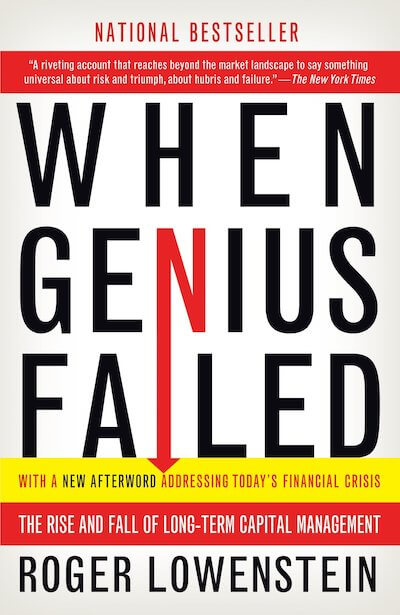
When Genius Failed Book Summary
This When Genius Failed Book Summary covers the key ideas, lessons, and takeaways in about 20 minutes.
Long Term Capital Management, a seriously successful hedge fund that amassed billions of dollars at its most successful had everything: huge investments from banks, elite wealthy investors, and people with PhDs in economics making their financial decisions. Most importantly, they had a sophisticated mathematical model that could predict market trends. According to their models, the most they could lose financially in a day would be $35. So how did that turn into losses of $533 million? Simple: there was one thing their model couldn’t predict. Read on to learn what the mathematical models missed, how cockiness can come back to bite you, and why sometimes it's better to take the more cautious approach to invest.
Want the complete 20-minute summary?
- Full structured summary
- Video Summary
- Podcast Summary
- Audio summary
- Key takeaways
- Exercises
- Quiz
- Highlights and notes
- Ask the book with AI
What is in the When Genius Failed book summary?
Below is a preview of Sumizeit’s expert-written summary of When Genius Failed by Roger Lowenstein. The full summary covers the book’s key ideas in text, audio, and video.
Ever heard the phrase, “Too much of a good thing?” While it's easy to think of this concept when it is applied to something like eating too much dessert (there is a limit to how much chocolate one can consume AND still enjoy) it's hard to imagine it could be applicable to genius or intellectual prowess. However, too much intellect can lead to too much arrogance, which can lead to the destruction of an otherwise extremely successful hedge fund. When Genius Failed, by Roger Lowenstein, chronicles how genius and arrogance lead to the failure of a hedge fund called Long Term Capital Management, which dominated the markets and had wild amounts of success in the early 1990s, only to come crashing down. Read on to learn about how mathematical models of the market were rendered useless by the unpredictability of human behavior, how cockiness can come back to bite you, and why sometimes it is better to take the more cautious approach to invest.
Long Term Capital Management was an extremely successful hedge fund. It was founded by John Meriwether in 1994. In case you aren’t familiar, hedge funds manage investments of wealthy folks. They are subject to very little regulation, so the size of the fund or where it is invested isn’t strictly regulated by any governmental bodies. Because they aren’t regulated, they can be invested in financial products that pose more risk to the investor. People who own hedge funds engage in a process called arbitrage. This is where managers of hedge funds buy or sell financial products in the hope that the price will change in their favor, and they will profit. Most successful arbitrage strategies are dependent on finding little inconsistencies in the prices of financial products. Sounds complicated, right? That’s why Long Term Capital Management hired academics and utilized software that gave them an edge which allowed them to notice and capitalize on these inconsistencies quickly.
Remember what we said above about profiting off of discrepancies? Well, the discrepancies were often small, so small that it would take a large sum of money for the discrepancies to yield and profit. Think about the difference between .099 and .1. It's not huge. But if you take the difference and multiply it by 500,000 or 1 million, you start to see a larger amount (even if in this example, it's still pretty small). So, even though Long Term Capital Management was receiving massive amounts of money from their investors, it wasn’t enough. So, they borrowed money from banks and encouraged investors to invest as much as possible. Banks were happy to lend Long Term Capital Management as much money as possible: especially since they seemed to be employing a strategy that involved very little risk. Since they were betting on discrepancies, a downturn in the market wouldn’t even necessarily be bad: it would just create more opportunities for discrepancies.
Want the complete 20-minute summary?
- Full structured summary
- Video Summary
- Podcast Summary
- Audio summary
- Key takeaways
- Exercises
- Quiz
- Highlights and notes
- Ask the book with AI
Who should read When Genius Failed?
When Genius Failed is essential reading for investors, finance professionals, and anyone curious about how markets actually work. If you want to understand the human side of financial risk and why mathematical models alone cannot protect against market crashes, this book reveals the costly lessons learned by some of the smartest minds in finance.
Why does When Genius Failed matter?
The collapse of Long Term Capital Management in 1998 nearly triggered a global financial crisis, yet the underlying causes remain relevant today. Roger Lowenstein's account shows how overconfidence, complexity, and the unpredictability of human behavior can undermine even the most sophisticated financial strategies, offering timeless warnings for modern investors and policymakers.
What are the key themes in When Genius Failed?
- The limits of mathematical models in predicting market behavior
- How intellectual arrogance leads to catastrophic risk-taking
- The gap between theoretical risk and real-world chaos
- Systemic financial risk and interconnection between institutions
- The role of human psychology in market crashes
- Leverage amplification and its hidden dangers
What are the key lessons from the When Genius Failed book summary?
Genius Without Humility Becomes Arrogance
Even Nobel Prize winners and elite academics can fall prey to overconfidence when surrounded by past success and intellectual prestige. When a team believes its models are infallible, it loses the caution necessary to survive market upheaval.
Mathematical Models Cannot Account for Human Irrationality
LTCM's formulas assumed markets would self-correct like a pendulum, but failed to predict panic-driven withdrawals and irrational behavior. Human psychology often overrides mathematical probability, especially during crises.
Leverage Multiplies Both Gains and Losses Exponentially
By borrowing 30 times their actual capital, LTCM turned small profitable discrepancies into massive wins—until the losses came, turning $35 estimated daily losses into $533 million in reality. Leverage is a double-edged sword.
Past Performance Is Not a Guarantee of Future Results
LTCM's string of profitable years created an illusion of invincibility that blinded managers to emerging risks. One crisis was enough to erase years of gains and nearly destroy the entire firm.
Complexity Can Hide Risk Rather Than Reduce It
Sophisticated financial strategies that even investors don't fully understand create hidden vulnerabilities. When banks finally examined LTCM's books, they were shocked at the true extent of risks being taken.
Systemic Risk Requires Government Intervention
LTCM was too large and interconnected to fail without triggering wider financial collapse. The Federal Reserve's bailout illustrated how individual financial institutions can threaten the entire economic system.
Correlation Breaks Down During Crises
LTCM's models assumed that certain asset classes would move independently; instead, during the Russian default and market panic, everything collapsed in tandem, invalidating their diversification strategy.
Small Discrepancies Require Massive Capital to Exploit
Arbitrage opportunities based on tiny price differences (.001 or less) can only generate real returns at enormous scale, forcing firms into the leverage trap and creating disproportionate risk exposure.
Lenders Share Responsibility for Excessive Risk
Banks lent freely to LTCM at minimal fees because they believed the hedge fund's models and had no oversight once money was deployed. Lenders enabled the dangerous leverage buildup despite their exposure to losses.
Crisis Abroad Can Rapidly Spread to Home Markets
The Asian financial crisis and Russian default demonstrated how interconnected global markets had become, turning distant geopolitical events into immediate threats to American financial institutions.
Regulatory Oversight Gaps Enable Concentrated Risk
Hedge funds' minimal regulation allowed LTCM to accumulate risks that would have been impossible for regulated institutions. Deregulation enabled the fund to grow too large too fast without appropriate safeguards.
Selling Assets in a Panic Creates a Death Spiral
When LTCM needed to liquidate positions to cover losses, the market realized few buyers existed for their holdings, forcing fire-sale prices and accelerating the collapse.
Overspecialization in Complex Strategies Creates Fragility
LTCM's entire edge depended on exploiting arbitrage opportunities that existed only under specific market conditions. When conditions changed radically, their only strategy became worthless.
Elite Credentials Are Not a Substitute for Risk Management
Having Nobel Prize winners on the board provided marketing credibility and investor confidence but could not prevent the firm from making catastrophic bets based on flawed assumptions.
Success Can Be a Liability If It Breeds Complacency
LTCM's early dominance of the markets prevented any serious questioning of the strategy or assumptions underlying their models, allowing dangerous blind spots to grow unexamined.
Confidence in Predictions Is Often Inversely Related to Accuracy
LTCM's most confident predictions—that daily losses could not exceed $35 or that they had calculated solutions for any problem—turned out to be disastrously wrong when reality diverged from the model.
Interconnection Between Institutions Amplifies Systemic Risk
LTCM's massive borrowings from numerous banks meant that its failure threatened the solvency of multiple major financial institutions simultaneously, forcing coordinated government intervention.
The Market Can Remain Irrational Longer Than Investors Can Remain Solvent
LTCM's models said the market was mispricedand would correct; instead, it remained dislocated for weeks while the fund bled capital it couldn't replace, proving that timing risk is as lethal as directional risk.
Transparency About Risk Must Come Before Growth
LTCM kept its investors and lenders largely in the dark about the true extent of its leverage and risk exposure until it was too late. Full disclosure could have enabled earlier course correction.
Financial Innovation Requires Robust Stress Testing Against Unknown Scenarios
No amount of backtesting against historical data can prepare a strategy for unprecedented events. True risk management must account for the possibility of market behavior outside all historical experience.
Want the complete 20-minute summary?
- Full structured summary
- Video Summary
- Podcast Summary
- Audio summary
- Key takeaways
- Exercises
- Quiz
- Highlights and notes
- Ask the book with AI
How can you apply ideas from When Genius Failed?
- Audit mathematical models and financial strategies against scenarios they were not designed to predict, including tail risks and unprecedented events
- Implement strict leverage caps and stress-test portfolios against multiple crisis scenarios to prevent catastrophic losses
- Ensure that investment leaders maintain healthy skepticism about past performance and regularly challenge core assumptions underlying their strategies
- Demand full transparency about risk exposure and leverage from investment managers before committing capital, particularly for complex or opaque strategies
- Diversify across uncorrelated assets while recognizing that correlations often break down precisely when you need them most during market crises
- Build governance structures that include independent risk oversight separate from profit-maximizing business units
- Recognize that sophisticated complexity can hide risk; simpler, more transparent strategies may offer better risk-adjusted returns
What common mistakes do readers make with When Genius Failed?
- Assuming that elite credentials and past success make a strategy immune to market shocks or model failure
- Using excessive leverage to amplify small profitable opportunities without fully accounting for what happens when the trade moves against you
- Believing that mathematical models can capture all relevant market dynamics, especially human behavior and panic responses
- Treating quantitative risk estimates (like LTCM's $35 maximum daily loss) as certainties rather than probabilistic estimates with real-world limitations
Sumizeit Exercises Apply what you've learned
Turn ideas from When Genius Failed into action with a short guided reflection: identify the biggest takeaway, connect it to your life, and commit to one step you can take in the next 24 hours.
What is the expert analysis of When Genius Failed?
Overview
When Genius Failed by Roger Lowenstein is a seminal work that chronicles the dramatic rise and catastrophic collapse of Long Term Capital Management (LTCM), a hedge fund that once epitomized financial genius. Lowenstein, an accomplished financial journalist with a distinguished career at The Wall Street Journal and a reputation for incisive analysis, brings to life the complex interplay between quantitative finance, human psychology, and market dynamics. The book stands out not only as a gripping narrative of financial hubris but also as a cautionary tale about the limits of mathematical models and the dangers of overconfidence in the volatile world of high finance.
Core Thesis
The central argument of When Genius Failed is that intellectual brilliance and sophisticated mathematical models, while powerful tools, are insufficient to master financial markets when divorced from a nuanced understanding of human behavior and systemic risk. Lowenstein contends that LTCM’s downfall was precipitated by an overreliance on quantitative strategies that failed to account for irrational market reactions and the unpredictable nature of crises. The book exposes how arrogance, amplified by academic prestige and technological confidence, can blind even the most brilliant minds to the inherent uncertainties and complexities of financial systems.
Strengths
- Compelling Narrative: Lowenstein’s storytelling is both accessible and richly detailed, making complex financial concepts understandable without sacrificing depth.
- Insightful Characterization: The portrayal of key figures such as John Meriwether, Myron Scholes, and Robert Merton humanizes the abstract world of hedge funds, revealing the psychological dimensions behind financial decision-making.
- Critical Examination of Quantitative Finance: The book provides a rare insider’s view into the triumphs and pitfalls of quantitative models, highlighting their strengths and limitations in real-world application.
- Broader Implications: Beyond the specifics of LTCM, Lowenstein draws attention to systemic risks in financial markets, regulatory gaps, and the moral hazards posed by unchecked leverage and complexity.
Critiques & Counterarguments
- Overemphasis on Arrogance: While arrogance played a role, some critics argue that Lowenstein underplays structural factors such as regulatory inadequacies and market interconnectedness that also contributed to LTCM’s failure.
- Limited Exploration of Alternative Strategies: The book focuses heavily on LTCM’s quantitative approach but offers less analysis of other investment methodologies that might have mitigated risk, potentially oversimplifying the complexity of financial innovation.
- Retrospective Bias: The narrative benefits from hindsight, which may exaggerate the predictability of the crisis and understate the genuine uncertainty faced by LTCM’s managers at the time.
- Competing Research: Behavioral finance scholars might critique the book for not sufficiently integrating insights into investor psychology and market sentiment that have since become central to understanding financial crises.
- Opposing Schools of Thought: Proponents of efficient market hypothesis could argue that LTCM’s failure was an anomaly rather than evidence against market rationality, suggesting that the book’s critique of quantitative models may be too sweeping.
Who Should Read This
When Genius Failed is essential reading for financial professionals, economists, and policymakers seeking to understand the interplay between quantitative finance and market psychology. It also appeals to sophisticated readers interested in the dynamics of risk, leverage, and systemic vulnerability in modern capitalism. Beyond the financial sector, the book offers valuable lessons for anyone intrigued by how intellectual hubris and complex systems can lead to unforeseen collapse, making it a compelling study for students of psychology, philosophy, and organizational behavior.
Frequently asked questions about the When Genius Failed book summary
What is When Genius Failed about?
When Genius Failed by Roger Lowenstein is the true story of Long Term Capital Management, a hedge fund founded by elite academics and Nobel Prize winners that became one of the most successful financial institutions in the 1990s, only to collapse catastrophically in 1998. The book chronicles how sophisticated mathematical models, excessive leverage, and intellectual arrogance led to a $533 million loss and nearly triggered a global financial crisis, requiring a Federal Reserve-coordinated bailout.
Who should read When Genius Failed?
Anyone interested in finance, investing, or understanding how markets actually work should read this book. It is particularly valuable for investors, financial professionals, policymakers, and educated general readers who want to understand the gap between theoretical finance and real-world market behavior, as well as the human factors that drive financial crises.
What are the main takeaways from When Genius Failed?
The primary takeaways are that mathematical models cannot predict human behavior or unprecedented market events, excessive leverage amplifies losses as much as gains, and even the brightest minds can fail catastrophically when overconfidence replaces humility. The book also demonstrates that individual financial institutions can become so large and interconnected that their failure threatens the entire economic system, requiring government intervention.
Why did Long Term Capital Management fail?
LTCM failed because its mathematical models assumed markets would self-correct after disruptions, but the 1997 Asian crisis and 1998 Russian default triggered panic-driven withdrawals and irrational behavior that the models could not predict. Combined with LTCM's excessive leverage (borrowing 30 times its capital), small market moves turned into massive losses that spiraled into a $533 million collapse within weeks.
How much money did Long Term Capital Management lose?
Long Term Capital Management lost $533 million in just a few weeks during the crisis of August 1998. This was dramatically more than their models predicted as their maximum possible daily loss of $35, illustrating the massive gap between theoretical risk calculations and real-world outcomes.
What does When Genius Failed teach about risk management?
The book teaches that risk management must account for scenarios outside historical experience, that leverage multiplies both gains and losses dangerously, and that overconfidence in models is itself a form of risk. It emphasizes that transparency, healthy skepticism, and recognition of human psychology's role in markets are essential for surviving financial crises.
Was Long Term Capital Management bailed out?
Yes, the Federal Reserve coordinated a bailout organized by major banks rather than allowing LTCM to fail outright. The Fed recognized that LTCM had become so large and interconnected that its collapse could trigger a broader financial crisis, making intervention necessary to protect the entire financial system.
About Sumizeit
Sumizeit is a profitable Scomy LLC company based in Miami, Florida. It has been helping readers learn from nonfiction books for 7 years with expert-written summaries in text, audio, podcast, and video.
Want the complete 20-minute summary?
- Full structured summary
- Video Summary
- Podcast Summary
- Audio summary
- Key takeaways
- Exercises
- Quiz
- Highlights and notes
- Ask the book with AI
Here's why readers love Sumizeit
Join thousands of learners getting smarter every day
"Great experience. Detailed summaries. Loved the gamification feature. Makes learning fun. Good customer service. I recommend Sumizeit to anyone. You'll learn a lot."
"I always felt busy but still wanting to keep up with the book discussion in my friend group. This was a great supplement to help me keep reading the books I find fun while keeping up with important books."
"I love this website. Instead of scrolling social media, I find myself learning a lot. I use it everyday. I recommend this app for anyone who is too busy and wants to get up to speed with their favorite books."
When Genius Failed Book Summary PDF
Looking for a When Genius Failed Book Summary PDF you can save and revisit offline? Our When Genius Failed Book Summary PDF captures the book’s core ideas in a clean, printable format — the key frameworks, takeaways, and structure without the fluff. Download the When Genius Failed Book Summary PDF when you want a reference you can annotate, share with your team, or review on the go. Get your When Genius Failed Book Summary PDF from the download page below.
Download When Genius Failed Book Summary PDFPeople also liked these summaries
Readers who explored When Genius Failed often enjoyed these titles next.




Want the complete 20-minute summary?
- Full structured summary
- Video Summary
- Podcast Summary
- Audio summary
- Key takeaways
- Exercises
- Quiz
- Highlights and notes
- Ask the book with AI
Featured Book Titles
Popular Book Summaries at sumizeit, leading book summary app
